A Comic About Marsh Linehan’s Legacy: DBT & Beyond
It’s not an overstatement to say that Dr. Marsha Linehan, the creator of Dialectical Behavior Therapy (DBT), has been an important figure in my life. Beyond benefiting from many of the skills and systemic changes her work created, my understanding of my own life and work as an artist has been shaped by her remarkable story and ethos around building a life worth living. In this post, I share the illustrated micro-biography I made about her. At the end, you’ll find a link to download the whole thing as a 2-page handout or a print-and-fold zine, so you can share her story, her work, and her legacy with others.
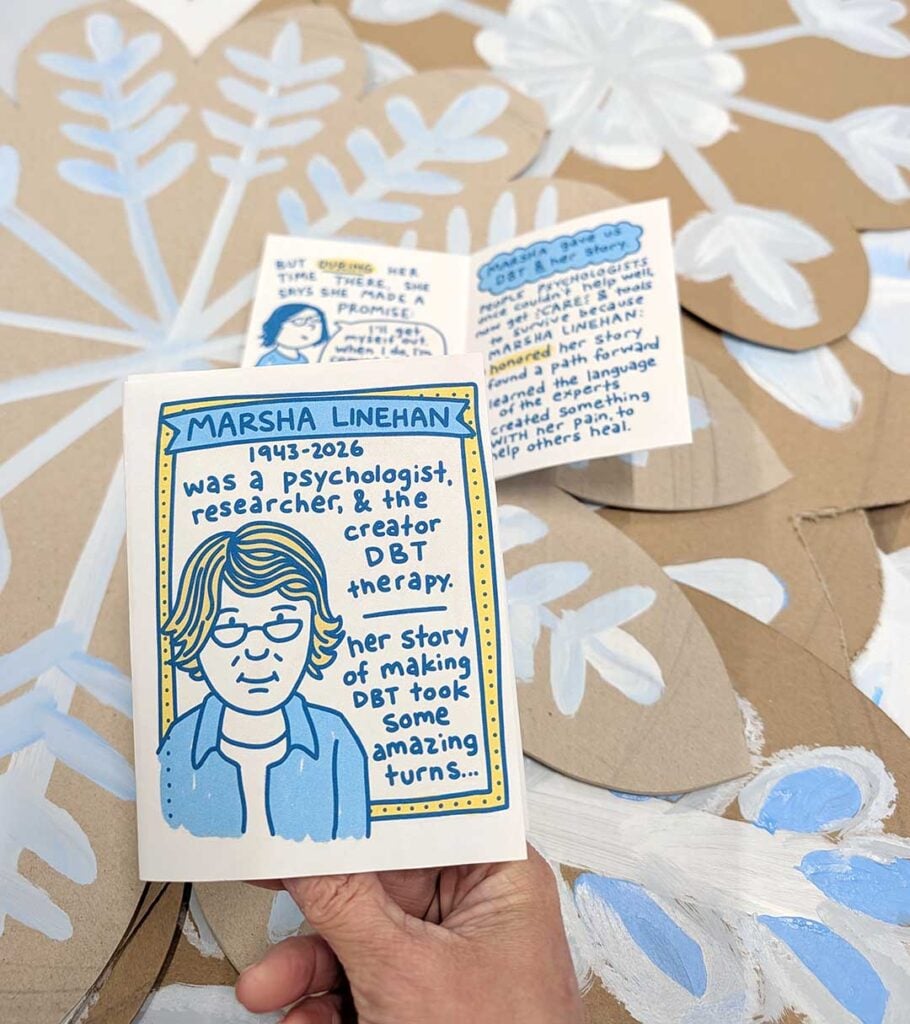
When we talk about counseling theorists, we’re usually talking about academic merits and accolades. Dr. Linehan had those- but she earned them through a surprising route. What I respect most about Dr Linehan is that, after surviving intense suffering, instead of putting her energy into forgetting painful memories, she kept growing, learning, and imagining how to help people who needed a different kind of care than what had been available to her.
That’s what I find most inspirational. As a therapist and artist, I want to follow her lead to honor my story, improve my skills, and imagine how I can use visual translation to make mental health resources more accessible to people who need materials in a format different from the norm.
Sketching Out the First Draft of My Marsha Linehan Zine
In a noteworthy twist of timing, I made the first draft of this zine on Monday, November 9, 2026. I just felt moved that morning as I was drinking coffee to share how incredible this woman and her story were. On Tuesday, November 10, this work became remarkably relevant when Dr. Linehan passed away in a Seattle hospital.
When I learned the news, I felt so sad and, at the same time, overwhelmed with gratitude for her work and the legacy she left behind. I knew I wanted to take my sketch from rough draft to final edit, almost as a way to channel my own sadness into something creative (I think Marsha would be proud of that, actually).

I knew from the start that I didn’t want to just create a biographical comic, or talk about only the academic and research value of her work. I wanted to make something more personal, because she gifted us tender parts of her story and, in that, there’s so much value. This zine is a small tribute to someone whose work changed how we understand emotional suffering, how we care for people in crisis, and what it can look like to build something meaningful from our own painful experiences.
The Comic Opens with Her Professional Story
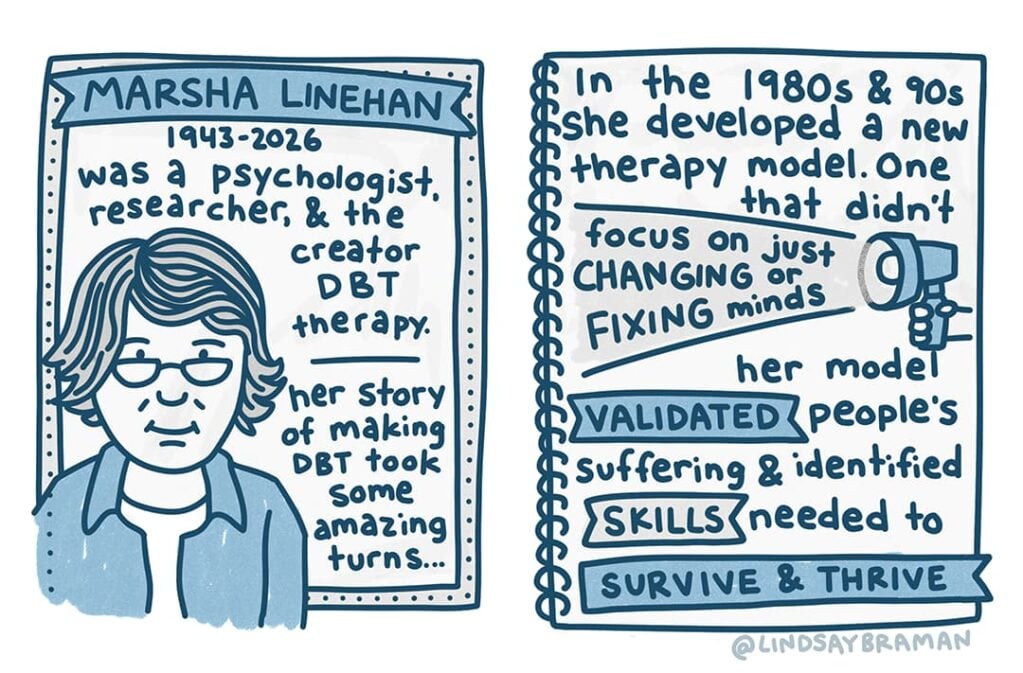
In the 1980s and 1990s (well, mostly the 80s, since the 90s were spent driving the research that showed the counseling community the model worked), Linehan developed Dialectical Behavior Therapy, commonly called DBT. Her approach challenged the idea that therapy should focus only on changing or fixing how people think and behave. (The Behaviorist movement that preceded her work insisted that people could feel and behave better *if only* they changed their thoughts- simple, right?!) DBT instead brought together two ideas that might seem contradictory: we can accept ourselves and our experiences as they are, while also working to change the things that are causing us suffering. That’s a dialectic, and it’s the foundation of DBT.
Then, We Learn that There’s More to the Story.
After Linehan’s model had demonstrated itself effective in study after study, after she was a respected thought leader in the field, and after DBT was beginning to expand- with success- into treatments for diagnoses she hadn’t originally targeted for the therapy (*but it’s not for everyone), she revealed something very personal: In 2011, Linehan publicly shared her history of psychiatric hospitalization and emotional suffering, revealing something that had not previously been part of her public professional identity. 1
Doing so sort of broke a mold. While the wounded healer archetype 2 has long been understood as a norm (that is: people are often drawn to medicine or counseling work because of pain they’ve experienced in their own past) a major theorist disclosing their own psychiatric hospitalization was groundbreaking- and a disclosure that offered hope to so many people.
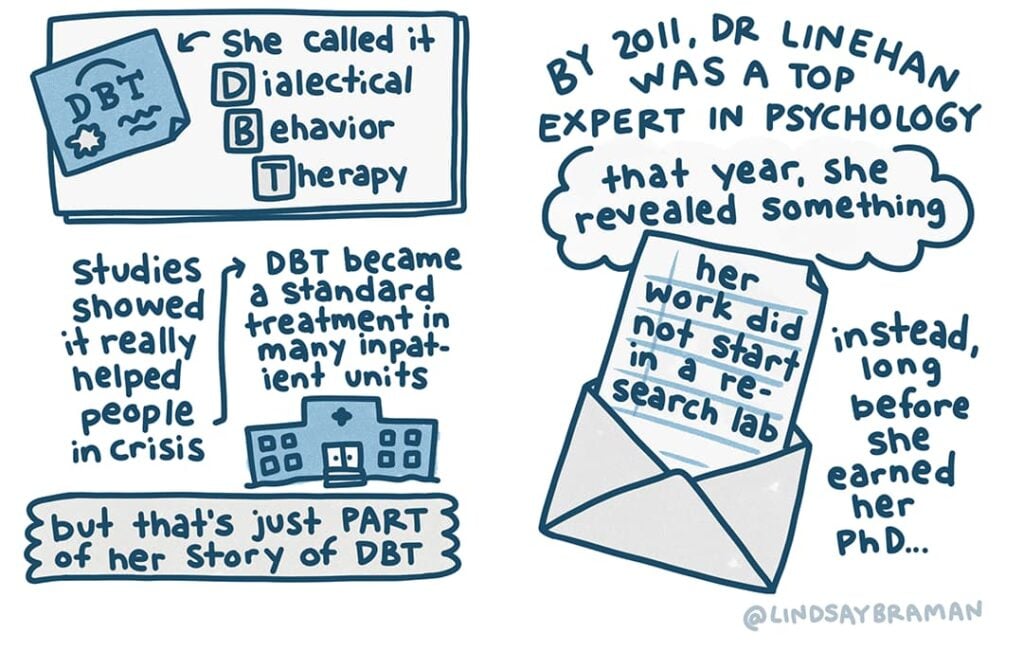
See, when Marsha Linehan chose to disclose this fact about herself, she also revealed that her work did not start in a research lab. Her work grew, in part because (maybe in spite of) her lived experience of being someone who needed care that didn’t yet exist.
Linehan’s Early Years
At age 17, Marsha Linehan was hospitalized in a psychiatric unit, where she spent more than two years inpatient. She later described that experience as “hell“. During her hospitalization, providers tried treatments including seclusion, shock therapy, and cold packs, but many of these interventions left her feeling worse. 3
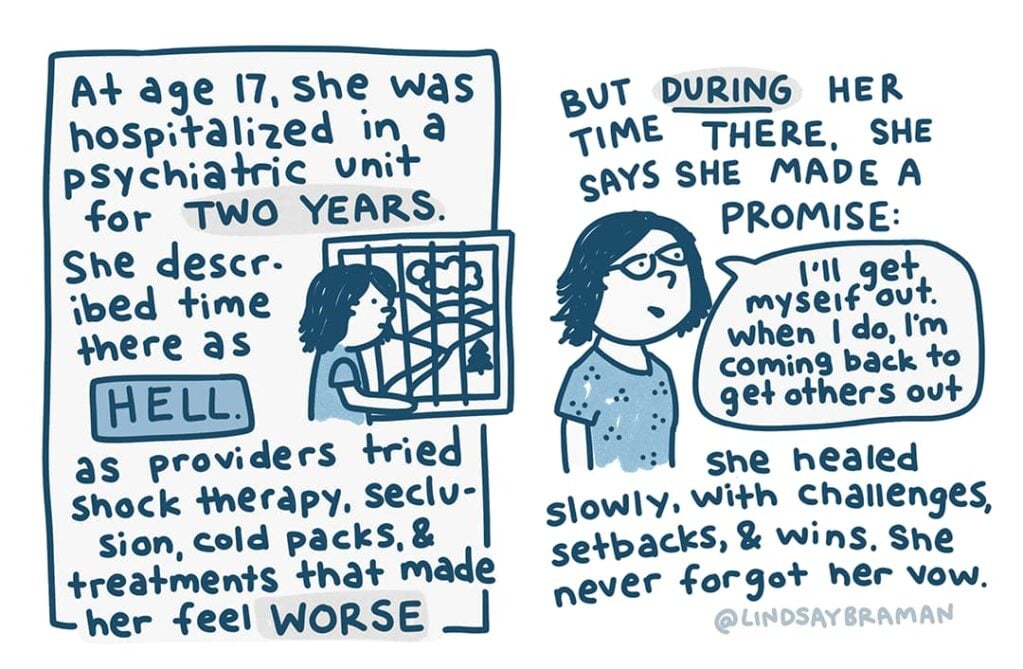
During that time, she made herself a promise: “I made a vow to God that I would get myself out of hell and that, once I did, I would go back into hell and get others out.” She credits that vow with guiding most of her life from that point on. 4
Research has found that DBT can reduce self-harm and suicidal behaviors among people experiencing significant emotional distress 5. Over time, DBT became an established treatment in many inpatient and outpatient mental health settings.
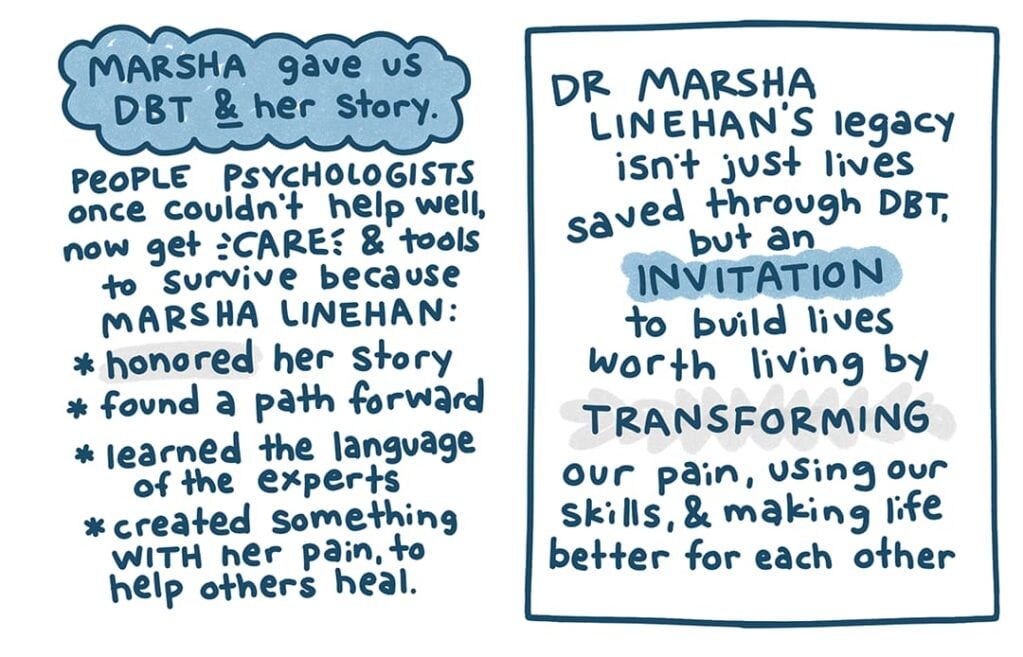
For people who had been told they were too difficult to treat, Linehan helped create another path forward. Then, she shared her story to help us all understand the power of transforming our pain in ways that build a better life- maybe even better lives for others.
Marsha Linehan’s Legacy Is An Invitation
The final panel of this zine is the part I most want people to remember: Marsha Linehan’s legacy isn’t just the lives saved through DBT. It’s also an invitation to imagine how we might build lives worth living by transforming our pain, using our skills, and making life better for each other.
Some Notes
When I create my illustrated mental health art, I spend a lot of time thinking about what information gets included and what gets cut- keeping it simple is really important.
I want you to know that to make this zine/comic, I had to edit out or simplify a LOT about DBT and Marsha Linehan’s life. There is so much more to her story than can fit into 2 pages of chunky handwritten text! So if this piques your interest, learn more! One way is by reading her memoir.
One of the things I cut, because this zine wasn’t really about DBT as much as it was Linehan’s story, is the Eastern influences of DBT- especially how mindfulness and radical acceptance have long been associated with Buddhism. I appreciate that Marsha Linehan credited these sources- never claiming to create DBT out of thin air. She drew from established psychological theories, including behavioral learning theory, cognitive behavioral therapy (CBT), and dialectical philosophy, which explores how two seemingly opposite things can both be true. Also, she spent decades formally studying and practicing contemplative Catholicism, then Zen Buddhism, eventually becoming a recognized Zen teacher herself. She drew ideas from different traditions, consistently acknowledged their origins, tested them through research, and assembled a practical treatment for people who weren’t getting the care they needed.
This digital download includes two products: an illustrated 8.5×11 biography page set and an 11×17 foldable zine.
The sketchnote biography comes in three color options: full color, black and white, and full color on a yellow background. The zine includes a printable template for easy folding!
Download and Share this Printable DBT Zine
If you’d like to learn more about Dr. Linehan, I recommend starting with her Wikipedia entry or her 2021 memoir, Building a Life Worth Living. Both offer a fuller picture of her life and work than I could fit into this little comic.
And if you’d like a printable copy of this Marsha Linehan zine to fold, share, or keep, you can download it.
I’d love for this art to help introduce more people to the woman behind DBT, and perhaps invite a few of us to think about what we might create with the stories, skills, and experiences we carry.
Image Description for Screen Readers
Two-page black-and-white illustrated handout about Marsha Linehan, drawn in a hand-lettered comic and zine style. The pages contain separate text panels, speech bubbles, banners, and simple cartoon illustrations. Some lettering is black on white, while other lettering is dark gray on a black background.
Page 1: The upper-left panel has a banner reading “Marsha Linehan 1943–2026” above a drawing of a woman with short hair, glasses, and a jacket. Text identifies her as a psychologist, researcher, and creator of DBT therapy. The upper-right panel resembles a spiral notebook and describes her development of a therapy model that validated suffering and identified skills needed to survive and thrive. A small hand holding a flashlight appears beside the text. The lower-left panel contains a drawing of a DBT booklet, the words “Dialectical Behavior Therapy,” a small hospital drawing, and text about studies of DBT. The lower-right panel has a cloud-shaped text box and an illustration of a letter emerging from an envelope, describing Linehan’s public disclosure of her personal history in 2011.
Page 2: The upper-left panel describes Linehan’s hospitalization at age 17, including a gray box containing the word “HELL.” Beside the text is a drawing of a young woman sitting behind a barred window. The upper-right panel contains a drawing of a woman with glasses and dark hair, alongside a speech bubble reading, “I’ll get myself out. When I do, I’m coming back to get others out.” Text above and below describes her promise and later experiences. The lower-left section has a cloud-shaped heading reading “Marsha gave us DBT & her story,” followed by handwritten text and a four-item bulleted list. The lower-right section is a large rectangular frame with handwritten text about Linehan’s legacy. The words “INVITATION” and “TRANSFORMING” appear in black lettering on irregular white shapes.
- Carey, B. (2011, June 22). Expert on mental illness reveals her own fight. The New York Times. https://www.nytimes.com/2011/06/23/health/23lives.html [↩]
- EBSCO. (n.d.). Wounded healer. EBSCO Research Starters. https://www.ebsco.com/research-starters/health-and-medicine/wounded-healer/ [↩]
- Linehan, M. M. (2020). Building a life worth living: A memoir. Random House. [↩]
- Linehan, M. M. [@DrLinehan]. (2020, January 4). [Post on Twitter]. Twitter. https://x.com/DrLinehan/status/1213464880100999171 [↩]
- DeCou, C. R., Comtois, K. A., & Landes, S. J. (2019). Dialectical behavior therapy is effective for the treatment of suicidal behavior: A meta-analysis. Behavior Therapy, 50(1), 60–72. https://www.sciencedirect.com/science/article/pii/S0005789418300492 [↩]