


Dr. John Gottman spent over four decades researching why relationships thrive or unravel- but it only took me a few hours to visually translate one of his key ideas, called “The Four Horsemen,” into literal ponies.
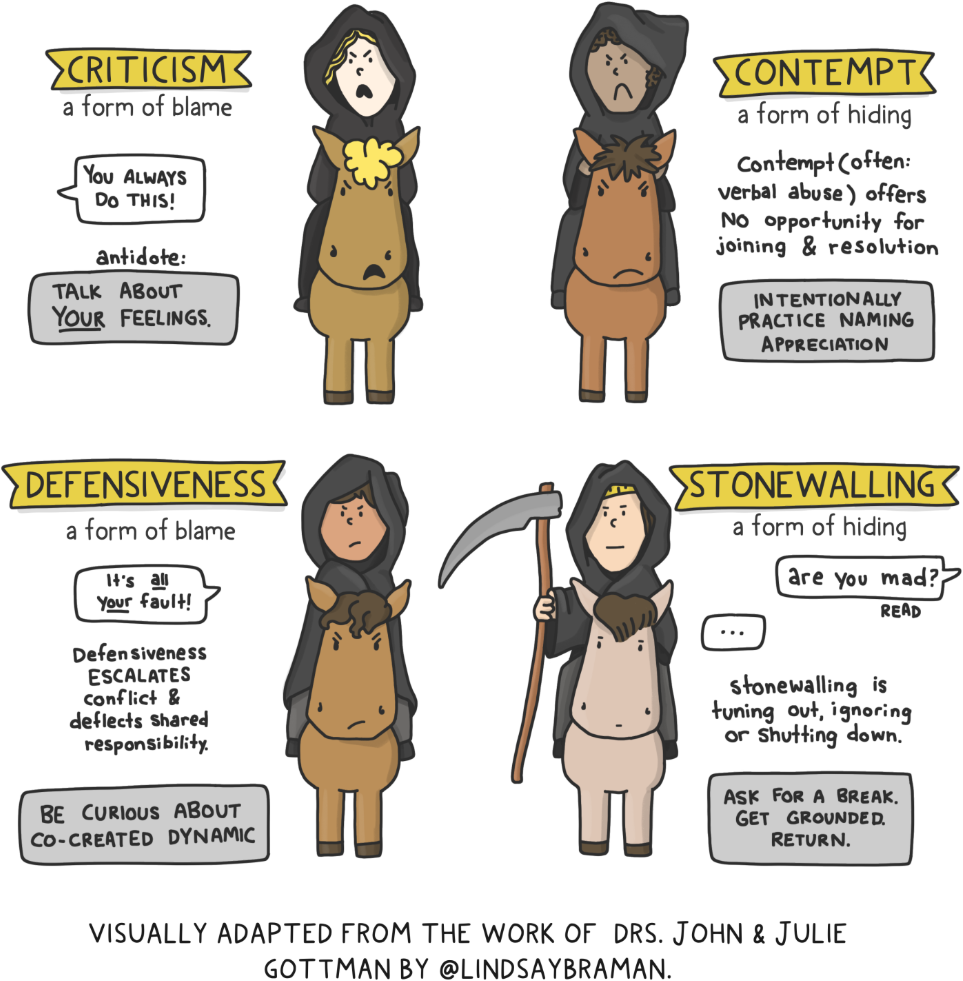
When I first learned about this theory in grad school, I couldn’t help but picture these “horsemen” as smaller, scrappier, more relatable versions. Not towering threats, but little angry ponies showing up in the middle of our arguments. I sketched them as a way to make the concept feel a little less intimidating. The result? An illustrated handout that’s now one of the most downloaded resources on my Patreon.
Gottman’s “Four Horsemen” represent four behaviors that, when they show up as patterns (not one-off events), can tank a relationship.
In fact, Gottman found that the presence of these communication patterns predicts divorce with ~90% accuracy. In other words, when researchers observed all four “horsemen” present in a couple’s communication patterns, that couple was 90% likely to end their relationship.
My art has changed a LOT since I made this little doodle years ago (while I was still in grad school!), but it’s still among my top downloads on Patreon. I think because it resonates with something we’ve all felt when we’re in conflict or going through relationship problems.
You can download the art below, or keep reading to learn more about this concept and my process of visually translating mental health concepts into printable, easy to understand handouts.
What the Four Horsemen Look Like in Everyday Conflict
These patterns show up in romantic partnerships, but they’re not limited to couples. I’ve observed these patterns in parent-teen relationships, adult children navigating hard conversations with aging parents, long-term friendships, and even roommates!
Most of us don’t need to memorize theory to know something is off. We feel it. It might make us uncomfortable, avoidant, or ready to pick a fight just to feel the relief of engagement.
This is where having the language to name patterns can help.
When we can recognize what’s happening, we can name it. And when we can name it, we can start to disarm it. And that can save a relationship.
I make visual resources because that’s how many of us learn. While some people find the tools to name and disarm through language, many of us are visual– or a combination of learning styles. That’s where an illustrated version might be helpful. While its cuteness is disarming, this illustration teaches through accurately representing the research findings.
A Quick Breakdown of the 4 Horsemen- As Ponies
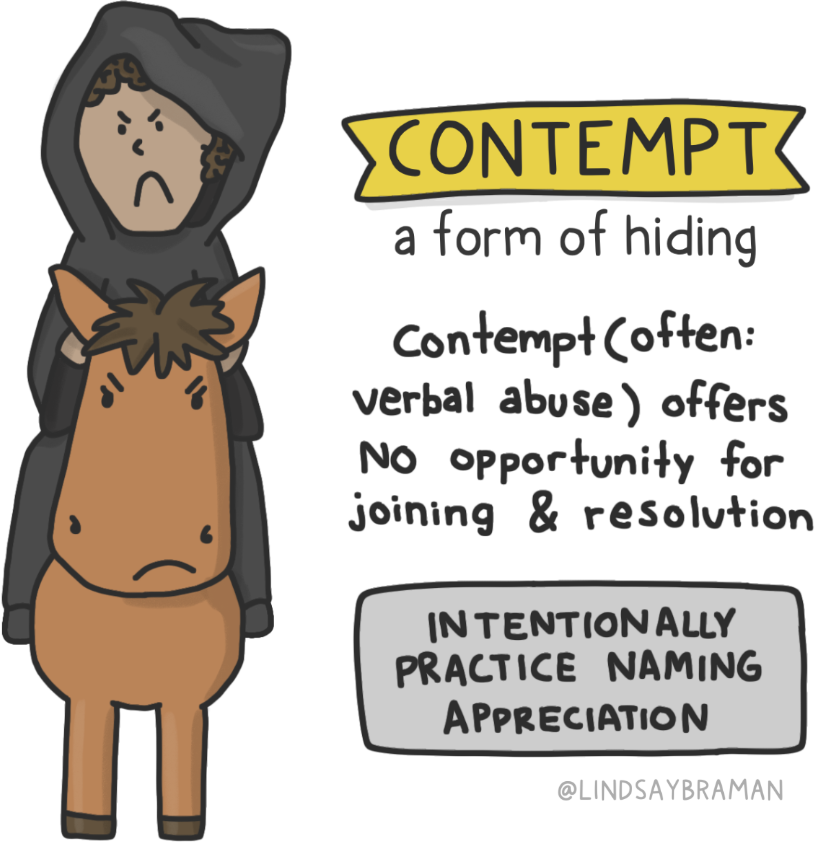
Contempt is that eye-roll, sigh, or sarcastic reply that shuts things down. It’s often fueled by deeper resentment.
Of all four horsemen, this one is most connected with relational breakdown. 1 When contempt rides in, we stop seeing the other person as someone we’re rooting for and start seeing them as someone we’re against.
Instead: Start practicing appreciation, even in tension.
Criticism points fingers. It sounds like “you always” or “you never,” and shifts attention away from how we’re feeling to what the other person is doing wrong.
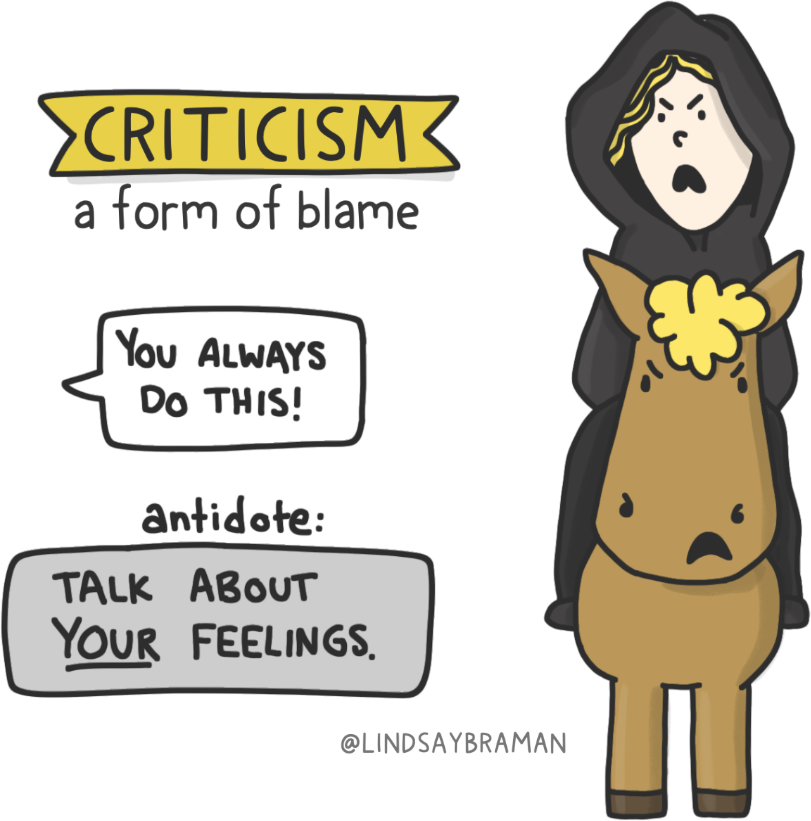
When we lead with criticism, we usually want connection. But we’re scared or angry, so we reach for something less vulnerable: criticizing.
Instead: Talk about what’s happening inside you. Try, “I feel hurt when…”
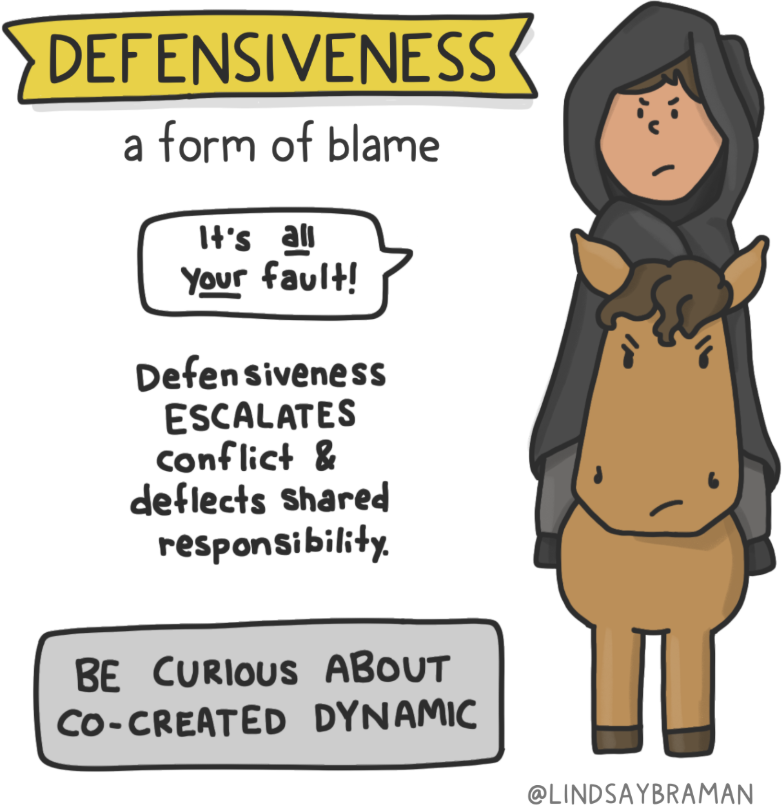
Defensiveness is self-protection that comes at the cost of connection. It often sounds like “It’s all YOUR fault!” – though sometimes in whispers and insinuations instead of loud accusations.
Defensiveness makes repair almost impossible, because it keeps us in a loop of blame and denial.
Instead: Try curiosity. Ask yourself, “What part of this might be mine to own?”
Stonewalling looks like tuning out, leaving a text on “read,” walking away mid-argument, or emotionally checking out. It might sounds like “fine” or “ok, whatever.”
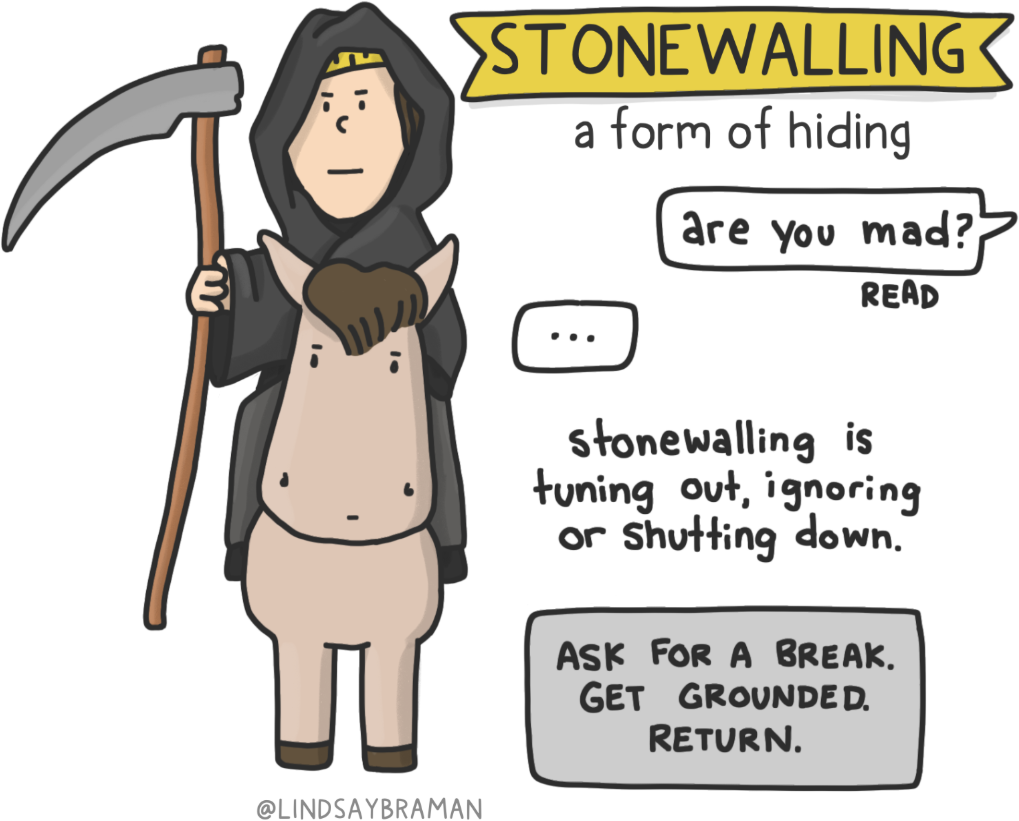
Sometimes it’s a choice. But more often, it’s a response to being outside our window of tolerance. It’s our nervous system saying, “I can’t do this right now.”
Instead: Take space with care. Say, “I need a few minutes to collect myself, let’s come back to this in an hour.”
Why This Handout Exists
When I first made the Gottman’s Four Horsemen of the Apocalypse Illustration, it was actually marginalia in my own class notes during a lecture on marriage and family counseling. But it’s turned into one of my most shared resources, especially by couples therapists practicing within the Gottman Institute framework.
Why? Because it gives people a way to talk about hard stuff without shame. It makes theory feel a little more human. And in clinical work, that’s half the battle.
How Therapists Use This Visual
If you’re a therapist or counselor, this printable was designed with you in mind. It’s printable, downloadable, and includes optional licensing for professional use (that means you can share it with your clients- read more about allowed use).
Download a digital copy of this art as a one-page handout for personal, professional, or educational use:
This wheel is available in multiple formats. My most popular download is this PDF.
This download includes the wheel in both color and black and white versions.
Image Description for Screen Readers:
Image 1: Text reads, “Communication patterns that destroy trust.” Yellow banner underneath with the text “Gottman’s 4 Horsemen of the apocalypse” on it.
Image 2: Drawing of a hooded person in all black with an angry expression on their face, sitting on top of a brown horse, who also has an angry expression. A bat is drawn in the corner of the image. Next to the drawing is a yellow banner with the word “Criticism” on it. Underneath in black text is “(also blame).” Below this is a speech bubble with the phrase written “You always do this!” At the bottom of the image is a box that says: “Talk about your feelings.”
Image 3: Drawing of a hooded person in all black with a sad expression on their face, sitting on top of a brown horse, who also has a sad expression. A bat is drawn next to this. To the right of the drawing is a yellow banner with the word “Contempt” on it. Underneath in black text is “(hiding).” Below this is more text that reads: “Contempt (often verbal abuse) offers NO opportunity for joining & resolution.” At the bottom of the image is a box that says: “Intentionally practice naming appreciation.”
Image 4: Drawing of a hooded person in all black holding an axe with a flat expression on their face, sitting on top of a brown horse, who also has a flat expression. To the right of the drawing is a yellow banner with the word “Stonewalling” on it. Underneath in black text is “(hiding).” Below this is a “read” text that says, “Are you mad?” with a responding text bubble with “…” inside. Underneath is more text that reads: “Stonewalling is tuning out, ignoring, or sometimes fear-based shutting down.” At the bottom of the image is a box that says: “Ask for a break. Get Grounded. Return.”
Image 5: Drawing of a hooded person in all black with a mad expression on their face, sitting on top of a brown horse, who also has a mad expression. To the left of the drawing is a yellow banner with the word “Defensiveness” on it. Underneath in black text is “(a type of blame).” Below this is a speech bubble that says “It’s all your fault!” Underneath is text that reads: “Defensiveness escalates conflict & deflects shared responsibility.” At the bottom of the image is a box that says: “Be curious about co-created dynamic.”
- Gottman, J. M., & Silver, N. (2015). The seven principles for making marriage work (Revised ed.). Harmony Books. [↩]



Thank you for making this accessible to those who use screen readers. I work with the visually impaired and this is refreshing to find!
You are very welcome!