Junk Journal
No blank pages- and no stuffy worksheets. Use my simple prompts to collect, curate, and create new strategies for accessing care from self, others, and your communities.
I used my training as a therapist and my own decades-long journaling practice to create my latest project: a guided junk journal designed for people who could use a book of visual reminders of ways to care for themselves. My guided junk journal is part journal, part scrapbook, part self-care workbook, and part art project. It’s for spreading out on your dining table to work on independently or for use as an facilitated activity in higher level of care settings. It’s for play, self discovery, and creating an archive of options for care.
Expand for Table of Contents
Table of Contents
Introduction & Concept Origin:
When we confide in a therapist or helping professional that we’re having a really hard time- like the kind of hard time where things are so dark that tomorrow might start feeling really hard to get to- therapists often turn to something called a safety plan.
A safety plan is a document that helps us plan for care in the darkest moments. Research says, safety plans really can help to get us from landmark to landmark on a journey through the landscape of crisis. 1 2 One theory for why crisis plans work is that they can engage our imagination for planning, seeking, and accessing care or positive feelings in the future.
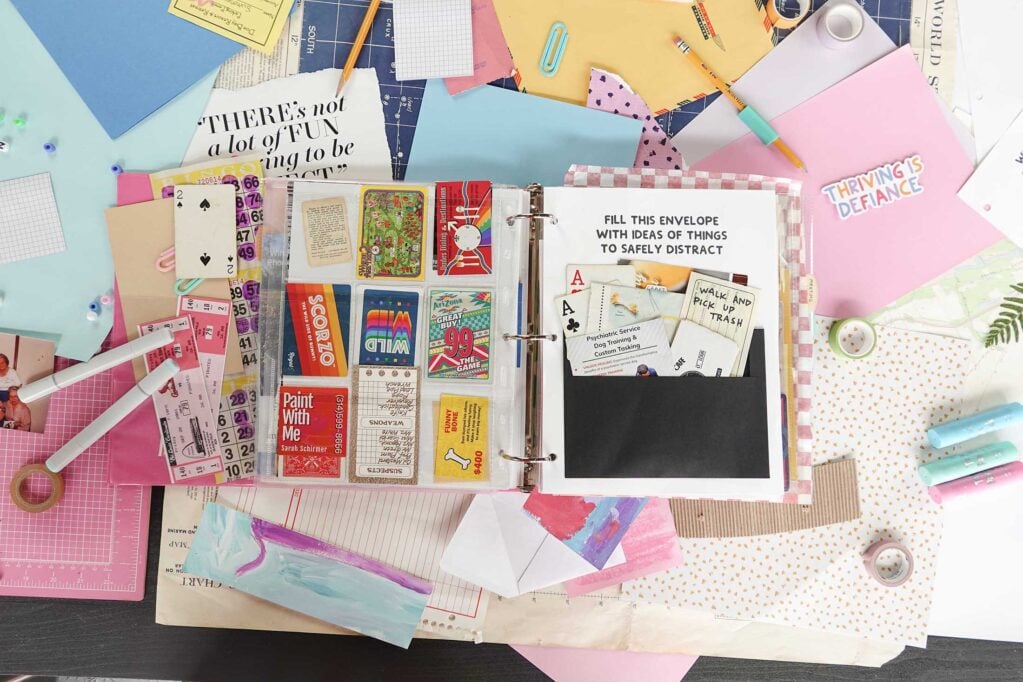
I took what I’ve learned about the best, most effective forms of crisis planning- and my own lived experienced for the ways my creative brain made it through the dark years in my early adulthood- and I spent 3 years creating my new project: The Guided Junk Journal for Radical Self Care on Very Bad Days.
About the Title
I know! It’s a very long title! (And its a good thing I’ve turned down publishers, because a traditional publisher would never!) but I picked it because I think sums up a few really important ideas:
1. It’s Guided – Journaling can feel really intimidating, especially when you’re really low. Worksheets can feel overly directive. My guided junk journal presents a simple prompt for each page and invites you to use it as a jumping off point.
2. It’s a Junk Journal – junk journaling is a creative practice built around collecting and using found materials. There’s no pressure to write responses or even to have any artistic skill. Find, collect, gather, print, and paste or tape into the book to create a book of care.
3. It’s for (Radical) Self Care – This journal has a purpose. It’s not a journal about self improvement or for practicing therapy skills- it’s about exploring what feels good to you in various realms (grounding, getting needs met, identity, community, etc). It’s for brainstorming how you can access that care, and creating a resource to share with others who want to care for you- if you choose to share.
The radical part comes, party, through accessibility. Most resources on growing self care practices ask the reader to articulate words to answer prompts. Mine doesn’t. For visual thinkers and tactile learners, you can respond to prompts (for example “meals that feel comforting” or “places I can go and sit quietly in public”) through photographs, recipes, business cards, clipped magazine articles, etc.
4. It’s for Very Bad Days – Work on this book on good, ok, or kinda bad days so that you’ll have it as a roadmap in Very Hard Days. Although the concept’s foundations are in safety planning, it’s for everyone! At least, anyone curious to learn more about themselves and how to get good care.
What this book isn’t: Although this project grew out of the research and theory behind crisis planning, it isn’t therapy. It isn’t a substitute for professional mental health care, crisis services, medication management, or treatment recommendations. It isn’t intended to diagnose, treat, or replace any aspect of mental health treatment.
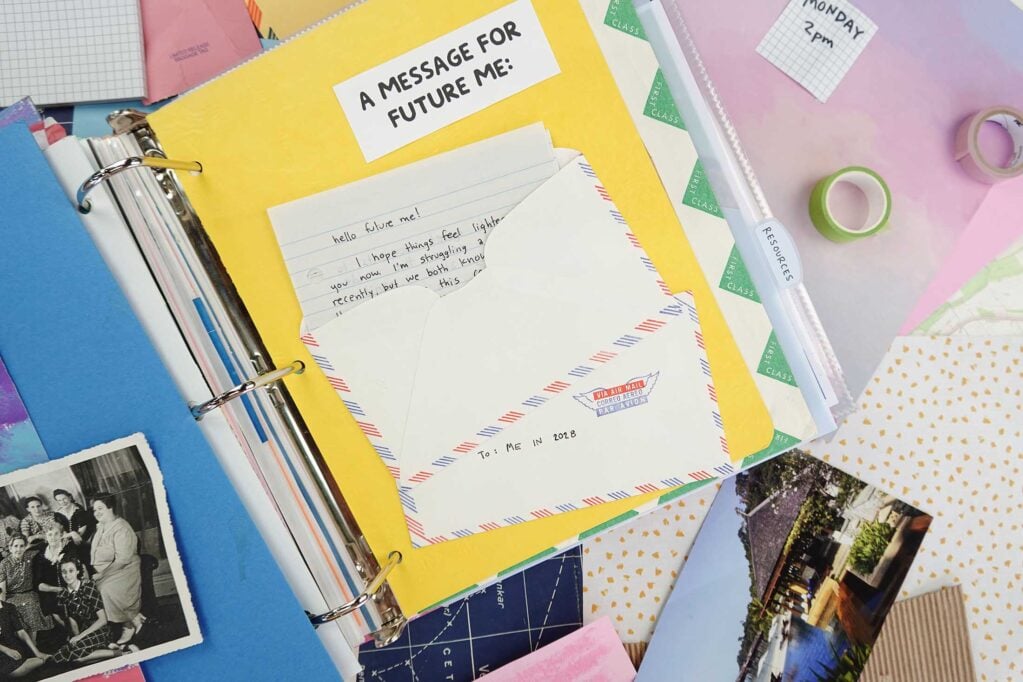
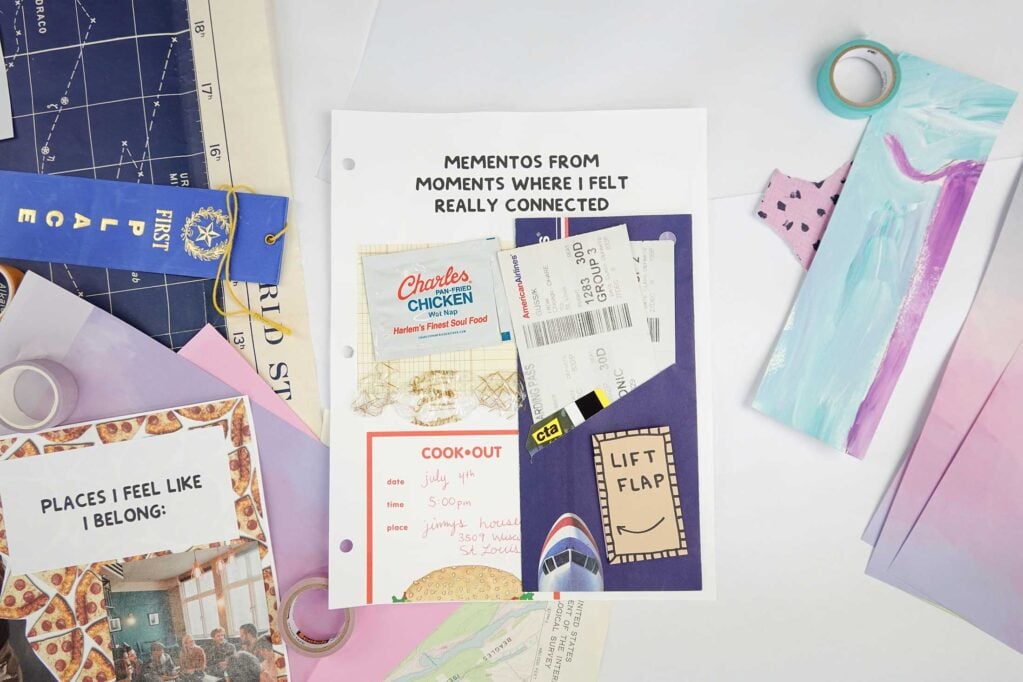
Is the Guided Junk Journal Right For you?
I don’t make resources for everyone, I make resources for folks who learn in ways that often aren’t recognized by major publishers. So let’s talk about whether you’re the sort of person who’s gonna “yuck” or “yum” my guided journal:
Who It’s For
- Visual thinkers, and people who enjoy creative expression, ages 12 and up
- With curiosity about junk journaling and/or a penchant for saving and archiving
- Teens and adults building support tools
- People not in active crisis, but who want to support themselves.
- Individuals working independently and groups (read more about how this resource can be used in IOP and PHP programs)
Who It’s Not For
- People in active crisis or very early recovery
- People who can’t yet access their creative spark following
- People who prefer highly structured worksheets
- People who dislike journaling or creative activities
- Analytical thinkers who think in words, lists, or numbers
- Everyone (it’s intentionally niche!)
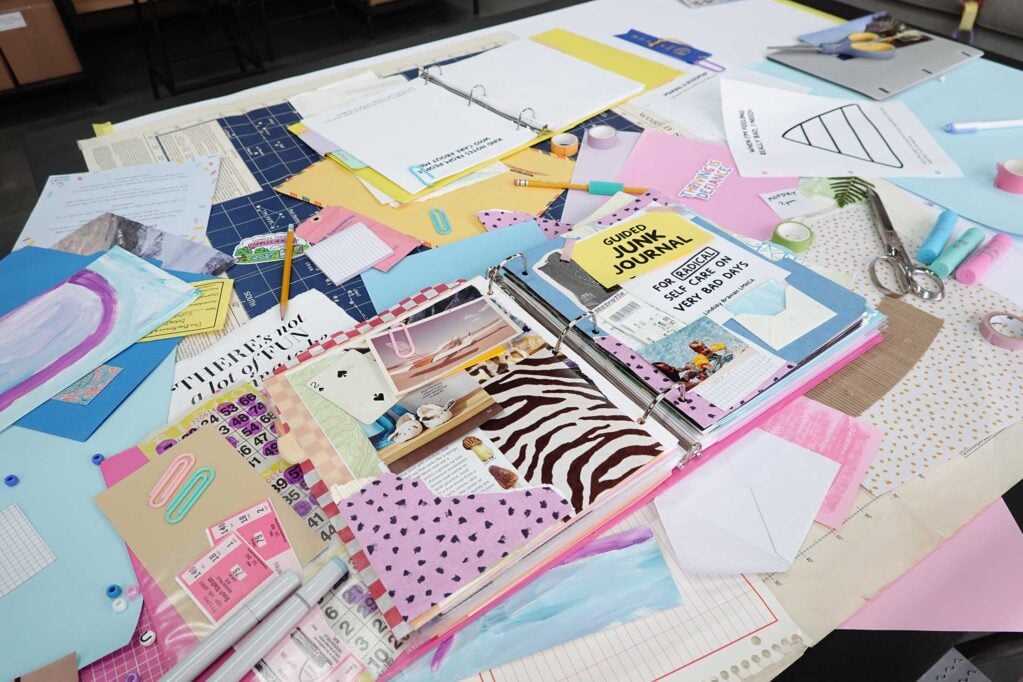
Note: The photos here feature my completed, filled out journal. The PDF download is 70+ pages of simple prompts to inspire the creation of your own junk journal.
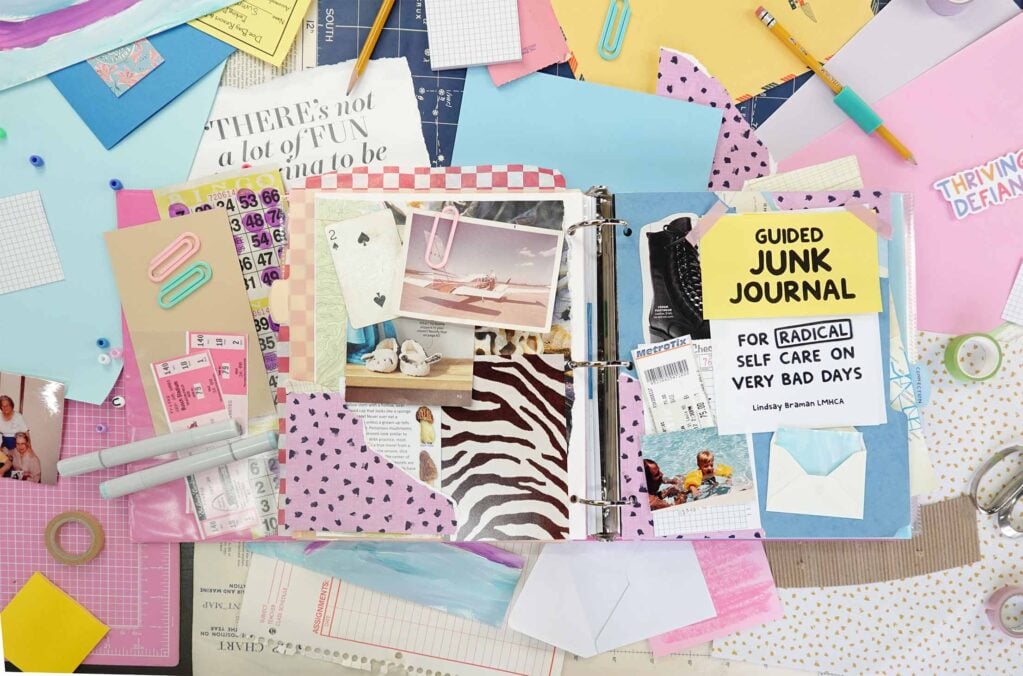
What Even Is a Junk Journal?
If you’ve never encountered junk journaling before, you might be wondering why my latest project as a mental health illustrator involved a year of me collecting maps, business cards, and handwitten cards.
Junk journaling is a creative practice that involves collecting and using found materials to create collages that communicate in images instead of words.
It’s art without the pressure of art making! Expressive arts therapies and art therapy have long used collaging as a form of therapeutic art making. Through collaging (and junk journaling) we can sneak around some of the complicated feelings we might have about making art (for example, performance anxiety or shame) and instead enjoy the process. As we paste together meaningful images, we can experience the healing that comes through art making. 3
It’s journaling without the constraints of journaling! Part of what I love about junk journaling is that it removes a lot of the pressure that comes with traditional journaling. When we think about keeping a journal, many of us imagine sitting down and writing thoughtful, coherent reflections every day. Junk journaling invites a much messier approach. Some days we write. Some days we collage. Some days we glue things into a book and call it a day. All of those things count.
It’s collecting in defiance of our minimalist overlords! Ok, not really. But Junk Journaling does give us permission to buck the “clean girl aesthetic” and reconnect with our childhood goblin who played through collecting, through noticing, organizing, and keeping objects that helped them understand the world around them. It’s a defined space for chaos, and that’s the fun.
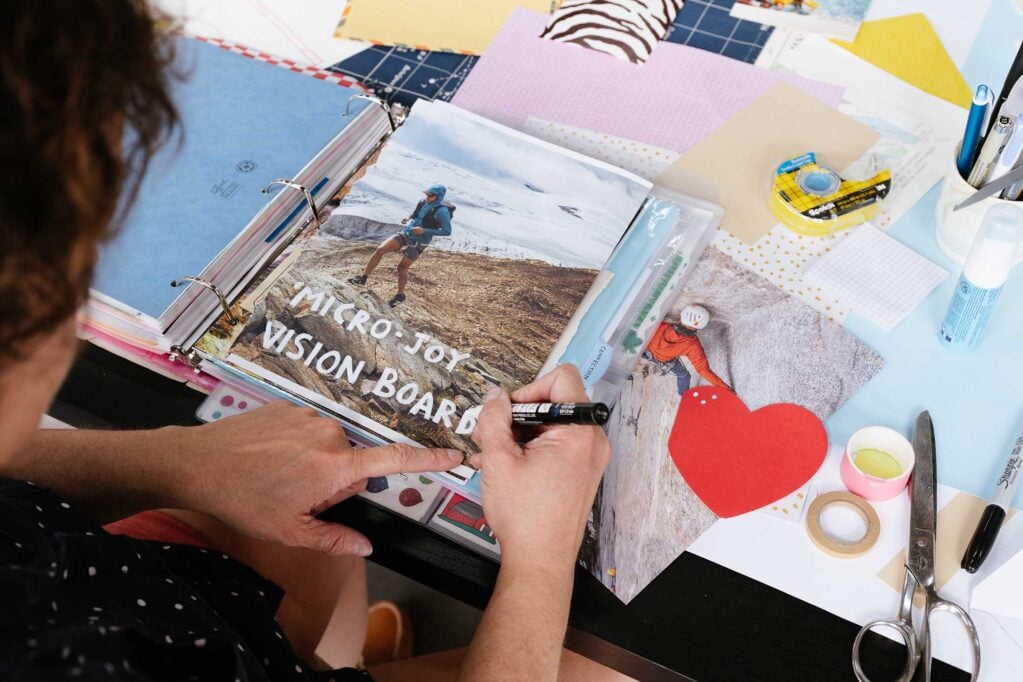
Junk journaling makes room for creativity without demanding perfection.
What You’ll Need
Truly, all you need to get started with my mental health informed guided junk journal is a glue stick, a pile of old magazine, and a can-do-attitude (or, well, just enough curiosity to prompt an attempt)
Half the fun of junk journaling is collecting materials that feel personal and meaningful to you – and those are the supplies that matter. Start keeping your eyes peeled for brochures, maps, and business cards. Can’t get out to forage? Use your printer to print your own!
That said, as a junk journaller I absolutely have a kit of supplies that make junk journaling easier and more fun to work on! Here’s my list. Please remember that as an Amazon Associate, I may earn a commission from purchases made through the affiliate links in this section. That commission helps support the creative work I share here.
Scotch Washi Tape
This is my favorite washi tape for functional journaling. It’s a little thicker and more opaque than many brands, which makes it perfect for creating labels over background images and text. Buy on Amazon.
Posca Paint Markers (Black + White)
I was slow to join the fan club for these markers, just junk journaling was definitely my induction. These paint pens write clearly over photographs, magazine clippings, patterned paper, and other busy surfaces. They’re perfect when you want to write directly on top of an image without losing readability. Buy on Amazon.
Kuretake Zig 2-Way Glue Pen
This is the GOAT glue stick. Get the broad nib and it makes gluing down an entire page fast and easy. Flip to a chisel side for way more control than a traditional glue stick. This glue is especially good at resisting buckled bubbly paper (the bane of my junk journaling existence!). Buy on Amazon.
Removable Double-Sided Tape
If you have commitment anxiety about gluing stuff down- this take is your ally. This removable tape lets me place pieces, move them around, and experiment before deciding where they belong for good. I love this tape because it will peel off even delicate paper without damaging- but the adhesive is (predictably) not super strong so you’ll want a glue pen as a second round of adhesive. Buy on Amazon.
Paper Trimmer with Decorative Blades
The most optional item from this list, I do really like my lightweight decorative paper trimmer. Little details like decorative edges can add visual interest and help pages feel playful, even when we’re journaling through difficult emotions. Buy on Amazon.
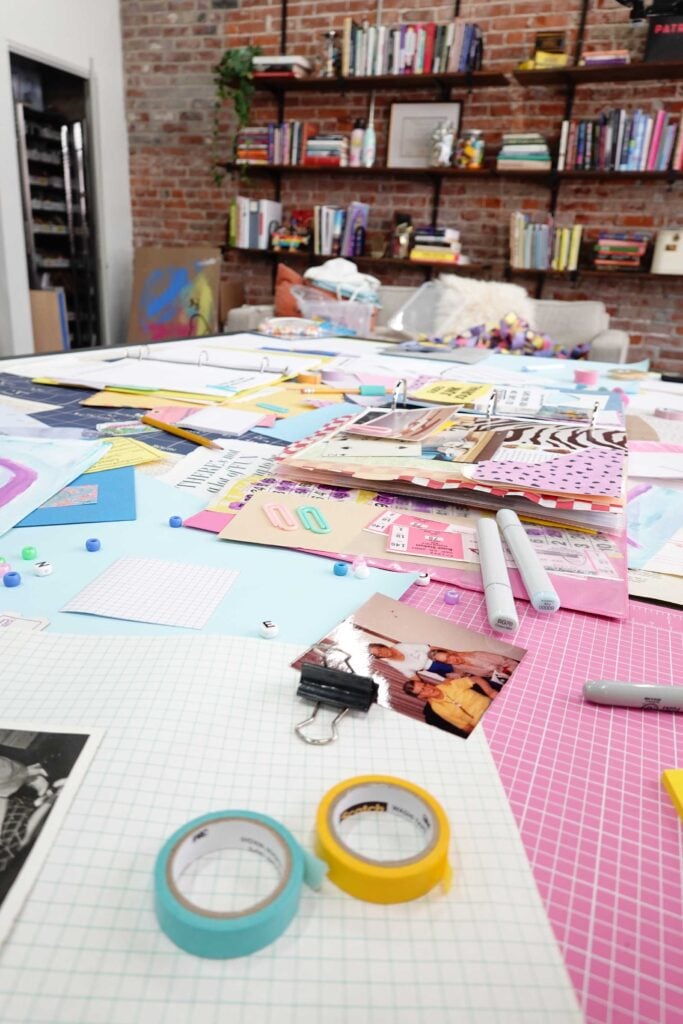
Explore the research supporting Junk Journaling as Supportive for Mental Health & Recovery.
Wait, Can Junk Journaling Really Help? – The Research
I’ve always loved journaling – as evidenced by the decades worth of archived journals in my bedroom closet. In other areas of my site, you’ll also find therapy journaling guides, bullet journaling layouts, and other journaling prompts. Some of my affinity for journaling comes from my training, but honestly, most of it comes from being a person who has always had a lot to express. I’ve drawn from the tradition of morning pages, artists notebooks (especially this exhibit at the American Folk Art Museum), and traditional journal practices to create my own journaling style that combines play. writing, deep reflecting, collaging, and creating. (In my personal practice, I’ve even begun binding my own journals from found paper and cutoffs from art prints made in my studio)
We know expressive writing helps us process
Many studies on expressive writing suggest that putting experiences into words can help us process emotions, organize thoughts, and make meaning from difficult experiences 4. But is junk journaling writing? Not quite– but it may even have more potential for healing than writing!
Visual Communication is powerfully expressive.
Hear me out: Communicating visually is just as expressive as writing long hand- in fact, many people report being able to express themselves more fully though visuals than through language. 5 Some research suggests collaging, like used in junk journaling, may offer additonal benefits. Junk journaling includes processes of selection, juxtaposition, and assembly, which can facilitate reflection and meaning-making in ways that differ from creating imagery through drawing or painting 6 One reason we struggle to access the benefits of visual art, however, is that we may feel shame or contempt towards our own skill at drawing or painting.
Junk Journaling offers double benefits of journaling and art making
Collaging (or junk journaling) can help us express our emotions in language and visuals- and because collaging takes much of the pressure off doing art “well”, it can be a workaround that circumvents shame while giving us the benefits of journaling. 7
Of course, journaling isn’t therapy, and it certainly isn’t a replacement for mental health care. But for many, a junk journal can become a tool along the road to recovery from mental illness, addiction, eating disorders, or self harm.
Is the Guided Junk Journal for Radical Self Care on Very Bad Days right for your IOP or PHP program?
My Guided Junk Journal for Radical Self Care on Very Bad Days in IOP, PHP, and inpatient programming?
I created this journal with IOP and PHP programs in mind. Years ago, my first placement as a trainee therapist involved co-facilitating an IOP group for individuals in recovery from substance use disorder. I learned so much from the individuals in that group. I also learned a lot about pacing all-day programs, and how a mid-day creative exercise with some breathing room could help participants reset and re-enter afternoon programming.
- Designed for use over days or weeks – My guided junk journal works especially well in PHP, IOP, and group therapy settings because pages can be distributed one at a time- the journal can be spread out over days or weeks as a daily supportive creative activity.
- Scaffold from basic self-care to skills to thrive – The journal progresses from establishing safety to brainstorming ways to get grounded and practice self-care, then continues towards building long term health-supporting behaviors (like community engagement, hobbies, volunteering, etc). This allows inpatient care teams to help participants build a personalized resource (that isn’t a boring white binder of photocopies! 😉) gradually as skills and insights develop through treatment.
- What you’ll need: All you need to get this activity started is books/magazines for collaging and some form of glue or tape. You can choose the loose leaf or saddle stitched version- they contain no staples and no sharp edges, making it suitable for environments with material restrictions.
Building Resources Before We Need Them
When we’re overwhelmed, exhausted, depressed, or struggling, it’s difficult to generate ideas. The things that seem obvious on a good day often become surprisingly difficult to access on a bad day. This is where planning ahead for bad days becomes a powerful ally in stabilizing after a mental health crisis, dealing with difficult days in addiction recovery, or handing challenges in recovery from an eating disorder.
That’s one reason I became interested in the idea of resource-building rather than crisis response. The Guided Junk Journal for Self Care of Very Bad Days isn’t designed to be completed during a crisis. In fact, I suspect most people would find it completely overwhelming if they tried to start it in the middle of one.
The guided junk journal isn’t planning for bad days. It’s gathering resources to get through them.
The Guided Junk Journal for Radical Self Care on Very Bad Days is designed to be built gradually, during good, ok, and kinda-rough days- not the worst days. On very hard days, the journal becomes an anchor, guide, and companion pointing us to connection points and good care.
How to complete it? However you need to!
- Do one page at your coffee table tonight.
- Another page in a therapy session tomorrow
- Three pages on saturday when you meet at a coffee shop with a journal collective in your area.
If you are in crisis or need help creating a crisis plan urgently, reach out to a mental healthcare provider in your area, contact the crisis text line by texting “home” to 741741, or call the Suicide and Crisis Lifeline at 988. The educational resources included on this site are not therapy and do not replace mental health treatment or crisis services. For more information see Terms of Use.
Create a page in my sample journal, or explore a full walk through
Some notes on context and appropriateness
In my life, I’ve had the challenge and the privilege to sit on both sides of a conversation about suicide prevention through crisis planning. I learned so much from my own journey and through sitting with others as they navigated those critical moments. Both perspectives informed a dream I’ve carried for years: What if crisis planning wasn’t something we just did in our worst moments, and the plan we created wasn’t just a clinical looking set of pages we immediately shoved to the bottom of our bag or the back of a drawer? What if there was a pathway to make a creative, interactive resource that scaffolded towards a crisis plan that actually felt personal, meaningful, and worth returning to?I’ve been holding this idea that crisis planning – which is, essentially , thinking and planning how to be really gentle with ourselves and how to get care on really really bad days – could be something we get to think creatively about on good and bad days. My Guided Junk Journal is an invitation to that.
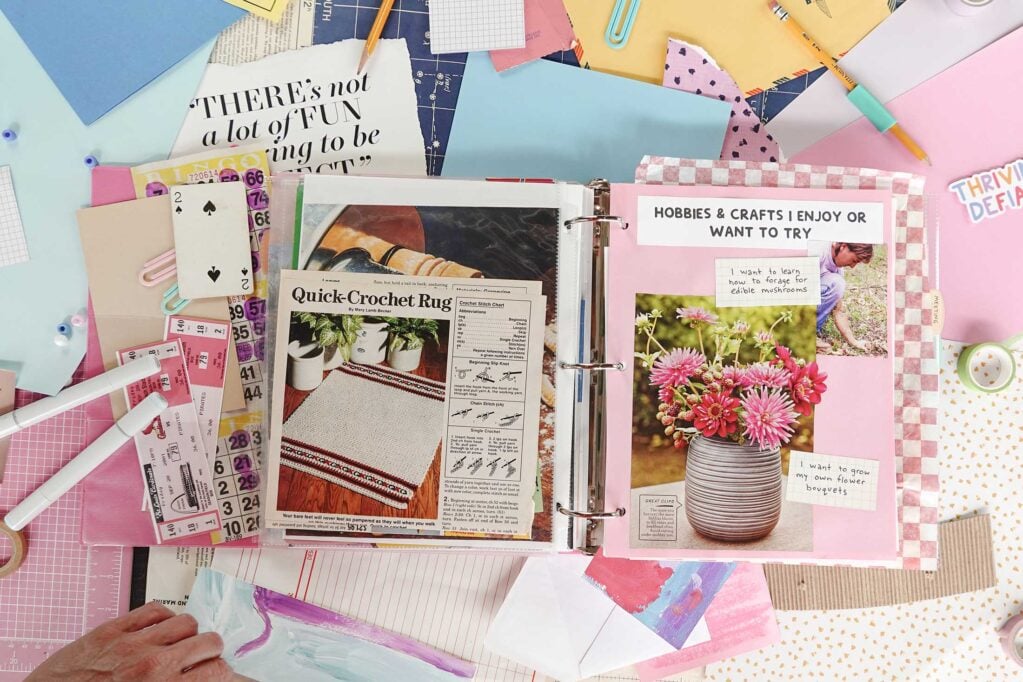
Who it’s for and what to expect:
While deferring to gentle language, this journal does directly address suicide and self harm in the context of prevention. While many pages are light, playful, and fun, you can also expect pages specific to suicide prevention: like pages that help guide conversations about seeking higher level of care, pages for a person to fill out with their therapists to build trust by framing expectations for what care to expect in a crisis, and fill-in-the-blank tear-out scripts for asking for care in moments if you’re not sure you can keep yourself safe.
This book is most appropriate for: Adults and older teens who are not in crisis currently. It’s designed for individuals who are already working with a therapist or care team, and who are feeling stable enough to access curiosity and creativity. It was created with recovery in mind: the guided junk journal makes a good gift for individuals in rehab for substance use, sober living homes, residential treatment center recovery programs for eating disorders, PHP and IOP programs for people recovering from a period of suicidality, transitional living programs, group homes, or programs currently using my DBT Activity Book.
What’s Inside?
It includes journal prompts that expand on a classic crisis plan. It helps the user explore ways to get grounded, safe distractions, ways to get needs met, people and communities that matter, and ways we’d like to be in the world. As one example, where a traditional safety plan might include a single blank titled “safe people you can talk to,” in the Junk Journal for Very Bad Days you’ll find:
- Pages inviting you to notice (and then write, draw, collage, or junk journal) the people you feel yourself around.
- Pages exploring the ways you feel most ok around people (for example, playing a sport, performing, or preparing food together)
- Prompts inviting you to paste in photos of people you love or print screenshots of supportive text messages.
- Pages inviting you to paste in cards or notes from people who care about you.
- etc.
- Ferguson M, Rhodes K, Loughhead M, McIntyre H, Procter N. The Effectiveness of the Safety Planning Intervention for Adults Experiencing Suicide-Related Distress: A Systematic Review. Arch Suicide Res. 2022 Jul-Sep;26(3):1022-1045. doi: 10.1080/13811118.2021.1915217. Epub 2021 Apr 29. PMID: 33913799. [↩]
- Marshall CA, Crowley P, Carmichael D, Goldszmidt R, Aryobi S, Holmes J, Easton C, Isard R, Murphy S. Effectiveness of Suicide Safety Planning Interventions: A Systematic Review Informing Occupational Therapy. Can J Occup Ther. 2023 Jun;90(2):208-236. doi: 10.1177/00084174221132097. Epub 2022 Nov 2. PMID: 36324257; PMCID: PMC10189833. [↩]
- Shukla A, Choudhari SG, Gaidhane AM, Quazi Syed Z. Role of Art Therapy in the Promotion of Mental Health: A Critical Review. Cureus. 2022 Aug 15;14(8):e28026. doi: 10.7759/cureus.28026. PMID: 36134083; PMCID: PMC9472646. [↩]
- Baikie KA, Wilhelm K. Emotional and physical health benefits of expressive writing. Advances in Psychiatric Treatment. 2005;11(5):338-346. doi:10.1192/apt.11.5.338 [↩]
- Silver, R. (2001). Art as Language: Access to Thoughts and Feelings Through Stimulus Drawings. Psychology Press. [↩]
- Chilton, G., & Scotti, V. (2014). Snipping, Gluing, Writing: The Properties of Collage as an Arts-Based Research Practice in Art Therapy. Art Therapy, 31(4), 163–171. https://doi.org/10.1080/07421656.2015.963484 [↩]
- Keisari S, Piol S, Elkarif T, Mola G, Testoni I. Crafting Life Stories in Photocollage: An Online Creative Art-Based Intervention for Older Adults. Behav Sci (Basel). 2021 Dec 21;12(1):1. doi: 10.3390/bs12010001. PMID: 35049612; PMCID: PMC8773113. [↩]