DBT Activity Book
DBT reimagined from the ground up through the eyes of therapist and illustrator Lindsay Braman.
or read more below

A Softer Intro to DBT
DBT materials can feel cold and clinical. The DBT Activity Book introduces all major skills using play, visual learning, and tactile activities.

Research-Backed
Aligns with research showing that we learn and remember best when we creatively interact with what we’re learning.

Therapist-Created
Lindsay completed training as a therapist before shifting her focus to creating mental health educational art.
Order direct from my Saint Louis art studio and I’ll pass the savings along to you!
or
get it super fast through Amazon Prime
- 96 pages
- Bleed-resistant 60 lb paper
- 8.5″ × 11.5″ pages
- spiral keeps book flat
- Top bound design = no spine interference for righties and lefties!
- Covers all DBT modules: mindfulness, distress tolerance, emotion regulation, & interpersonal effectiveness
About My Workbook Alternative: The DBT Activity Book
Picture this: a DBT workbook that doesn’t feel clinical, overwhelming, or cold. The therapy tools inside are presented in a playful, interactive format inspired by 1990s‑era activity books! That’s exactly what I had in mind when I made the DBT Activity Book.
In this article, I’m introducing my new work (and the research behind it) to those who might be curious, skeptical, or just looking for more information before purchasing. Ready to go ahead and take the leap? Jump right to ordering the book (through my site for standard shipping, or Amazon for express options) or accessing the pages digitally through my Patreon.
Table of Contents / Roadmap to this Post:
- We’ll start by talking about where this book came from – why I created a DBT activity book that doesn’t look or feel like other therapy workbooks.
- Then I’ll walk you through what’s actually inside the book, page by page, so you can get a sense of how it works and who it’s for.
- Next, I’ll share some of the research behind why creative, visual, and interactive learning isn’t just fun—it actually helps us recall and use DBT skills when we need them most.
- After that, I’ll talk about what makes this book different from traditional DBT resources, especially for neurodivergent and visual learners.
- Finally, we’ll wrap up with some FAQs, a quick summary of the highlights, and where to find the DBT Activity Book if it feels like a good fit for you or your clients.
More about My DBT Book:
Marsha Linehan used her personal experience to create DBT for people who needed a different kind of care. In that same spirit, my DBT Activity Book aims to bridge another gap: delivering more accessible DBT education for visual learners, neurodivergent individuals, and anyone who struggles with clinical-looking materials.
The DBT Activity Book is not just standard DBT worksheets regenerated with a cute filter. Instead, each page of the DBT activity book was hand-illustrated by me, a real human artist, trained therapist, and visual thinker with a knack for reimagining concepts in completely new visual formats. In addition to a visual reimagining, my visual DBT worksheets replace clinically-coded language and formatting with engaging, approachable words and visuals.


More About the Author: I’ve made a career of integrating deep research, clinical experience as a therapist, and my perspective as a learner whose educational journey required constantly adapting resources for my visual learning style. You can learn more about me, my training, my and my previous clinical work on my About Me page.
Let’s talk about what’s inside, and then I’ll share a little about the research behind why this format works (and why thousands of therapists are using my visual study tools to pass their board exams).
The very first page I released from this DBT Activity Book went viral within hours, amassing 70,000 likes.
What’s Inside:
An activity book can be hard to buy online, so here’s what you’d see if you stumbled on this book in your favorite independently owned bookstore and casually flipped through the pages:
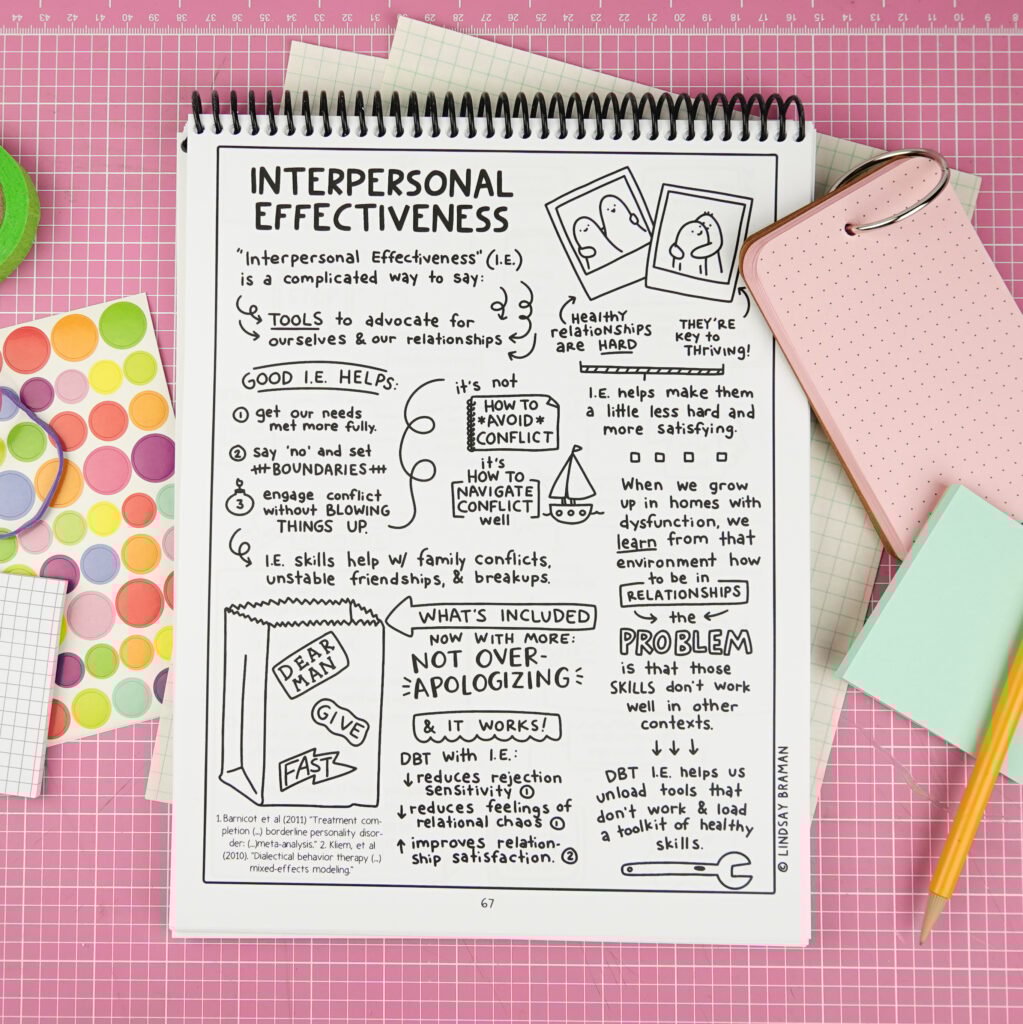
Lindsay’s signature sketchnotes offering visual overviews to introduce each module at a glance before any skills are introduced. Read or color-in these pages!
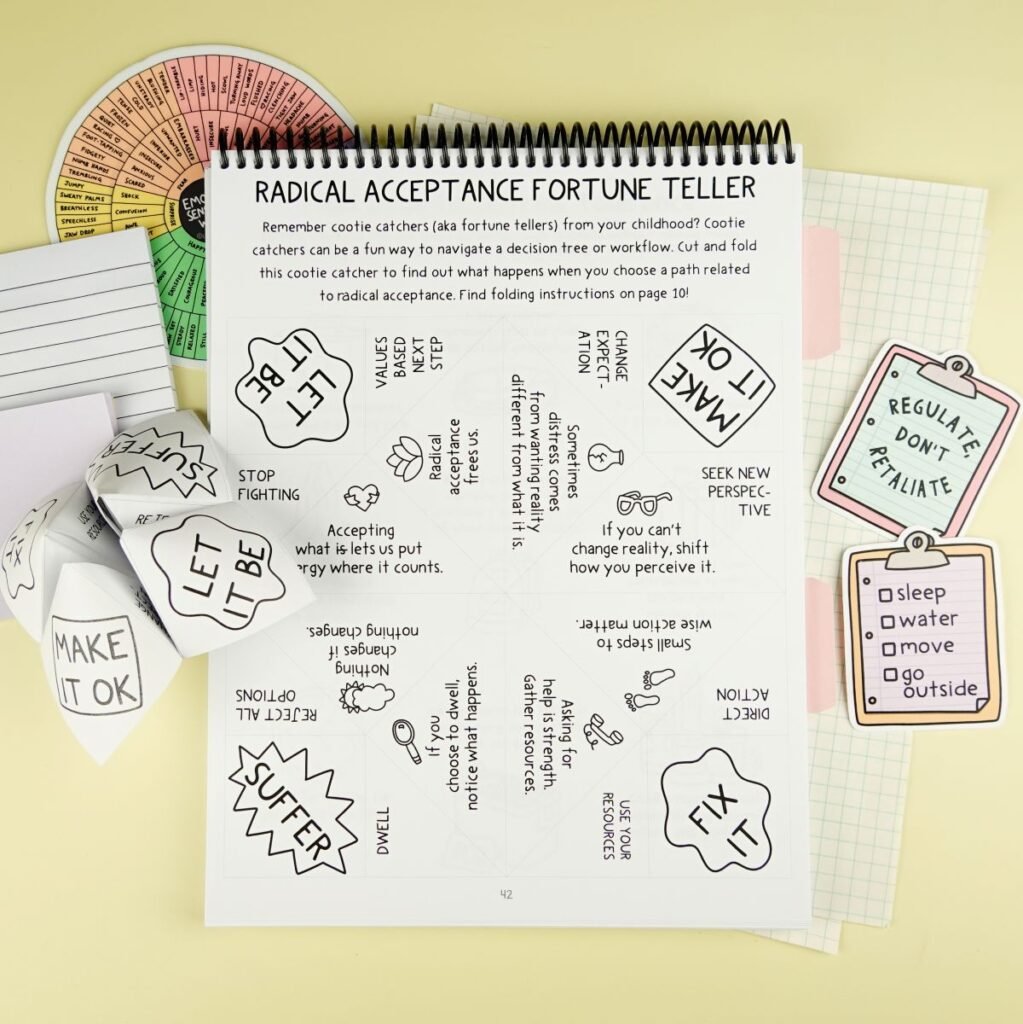
1990s Inspired Activity Book Games: You’ll find a crossword, origami games (for mindfulness and for radical acceptance), matching activities, bingo, and even a maze!!
12 Coloring book pages explore the idea of DBT skills as rooms in a safe cozy home. Each coloring book page invites the user to color a dopamine-decor-filled room in this home while also interacting creatively. For example: in the mindfulness-themed coloring page, users get to label bottles of soap with scents they find soothing and complete the book cover by adding a title of a book.
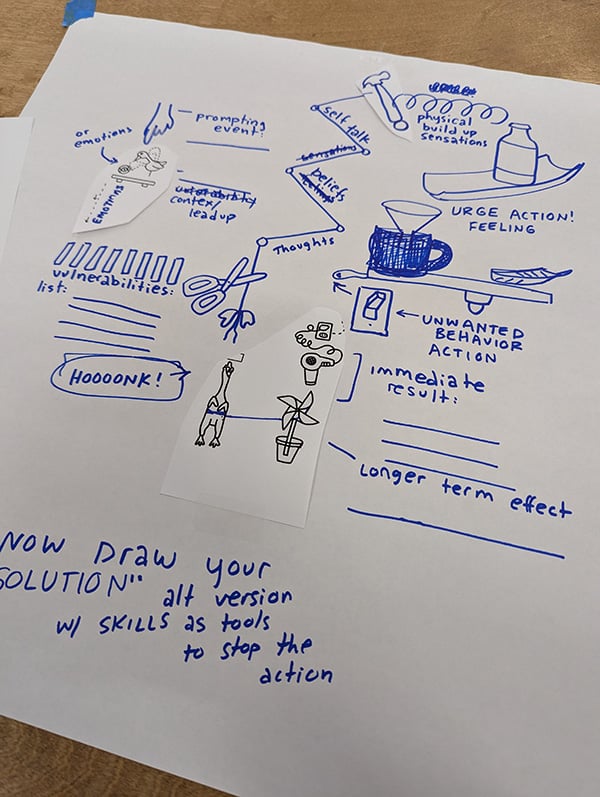
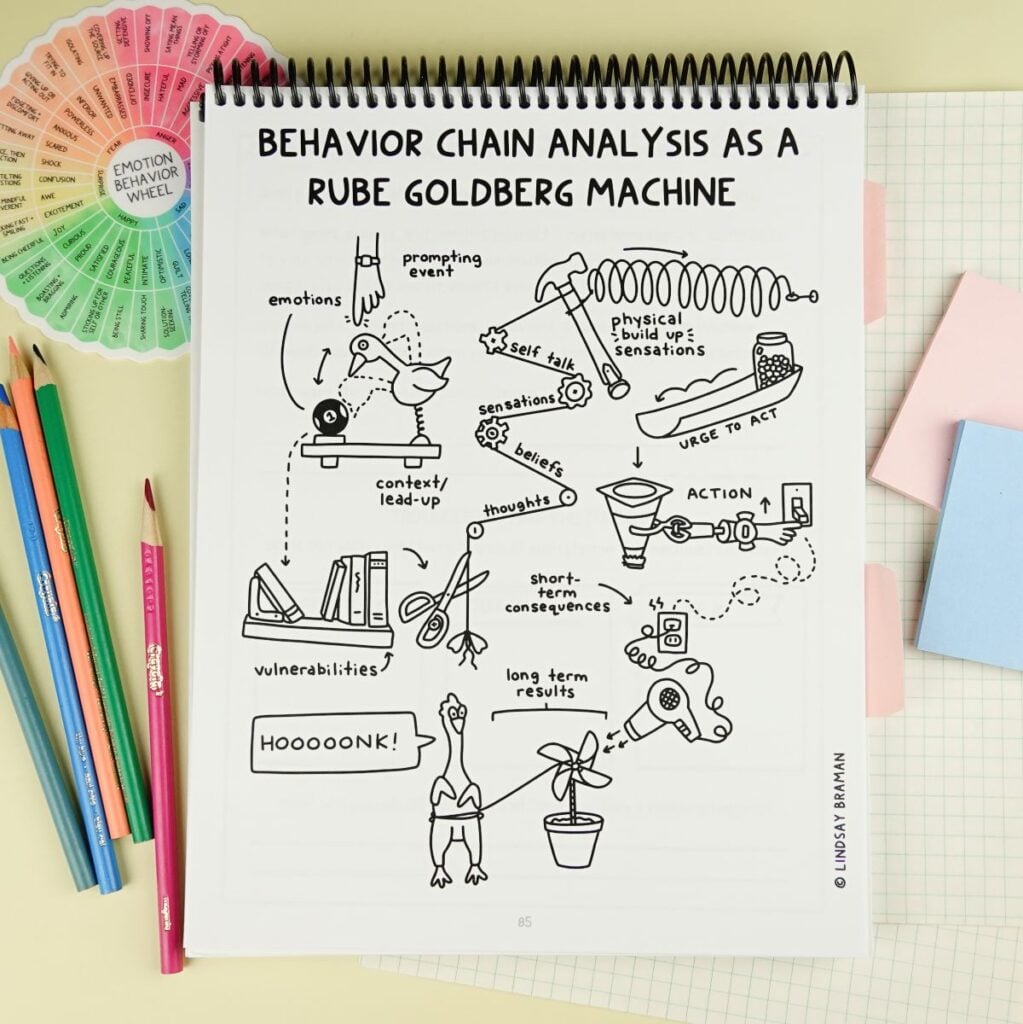
Worksheets with a Playful Take: for example, behavior chain analysis reimagined as a Rule Goldberg Machine. My worksheets let users fill out scales, spectrums, speech bubbles, and icons instead of long text boxes.
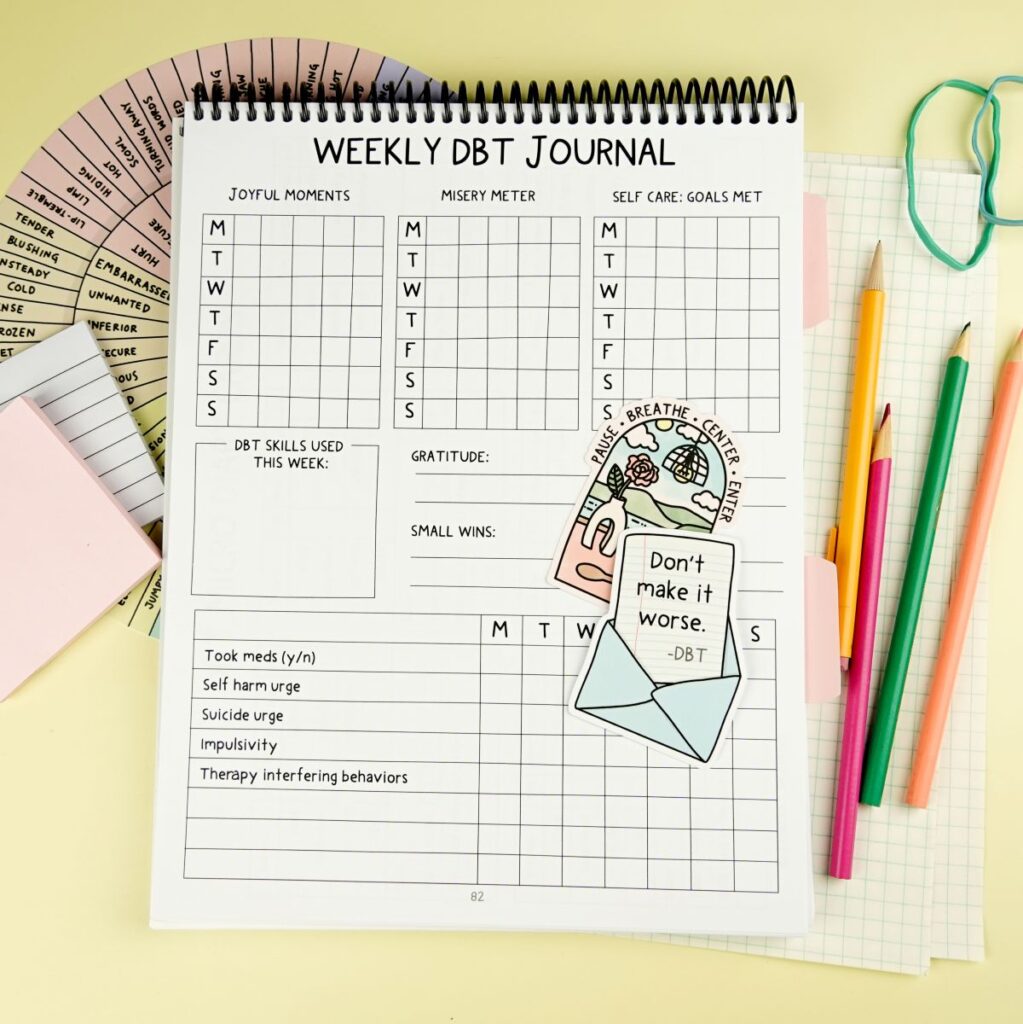
Guided journal pages including 3 alternative versions of DBT Diary Cards, designed for people who feel overwhelmed by standard DBT diary cards.
New wheels for visualizing Dialectical Behavior Therapy skills (example: a distress tolerance skills wheel and an opposite action compass).
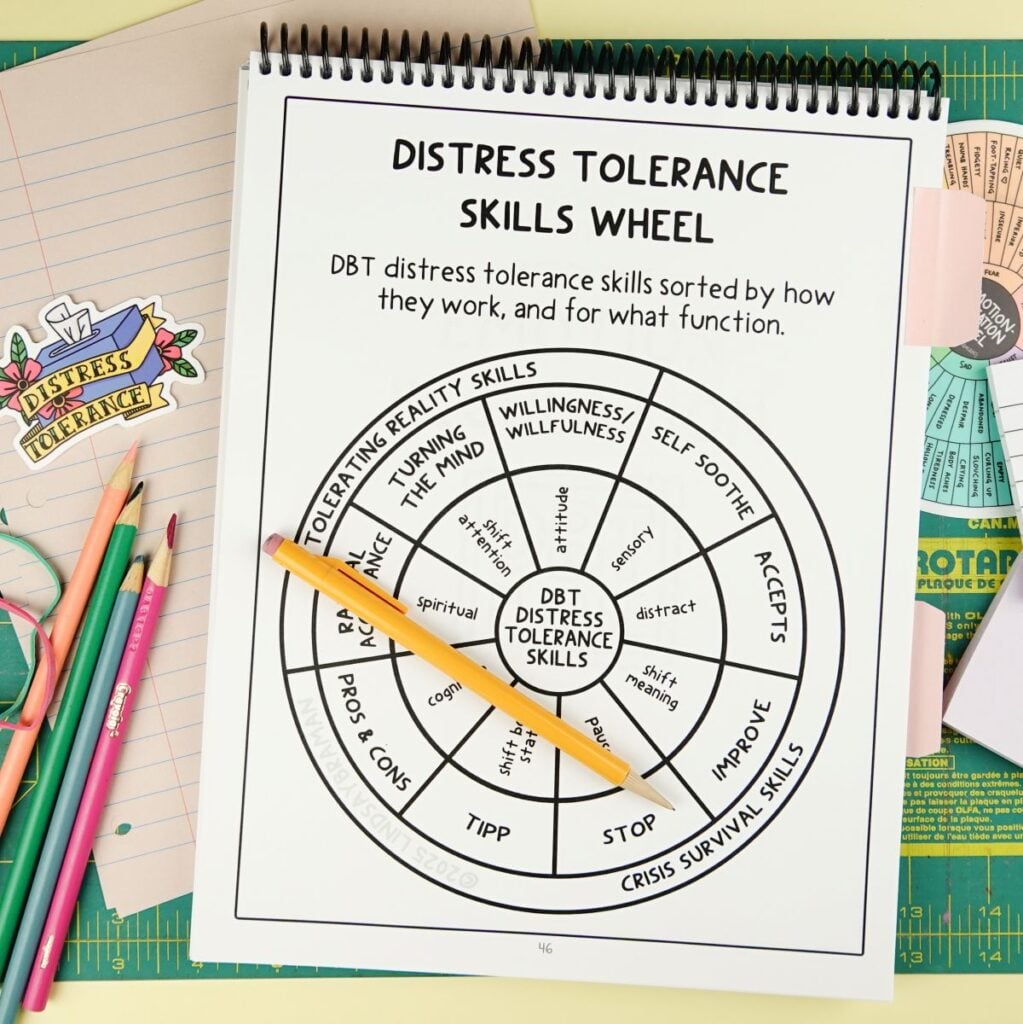
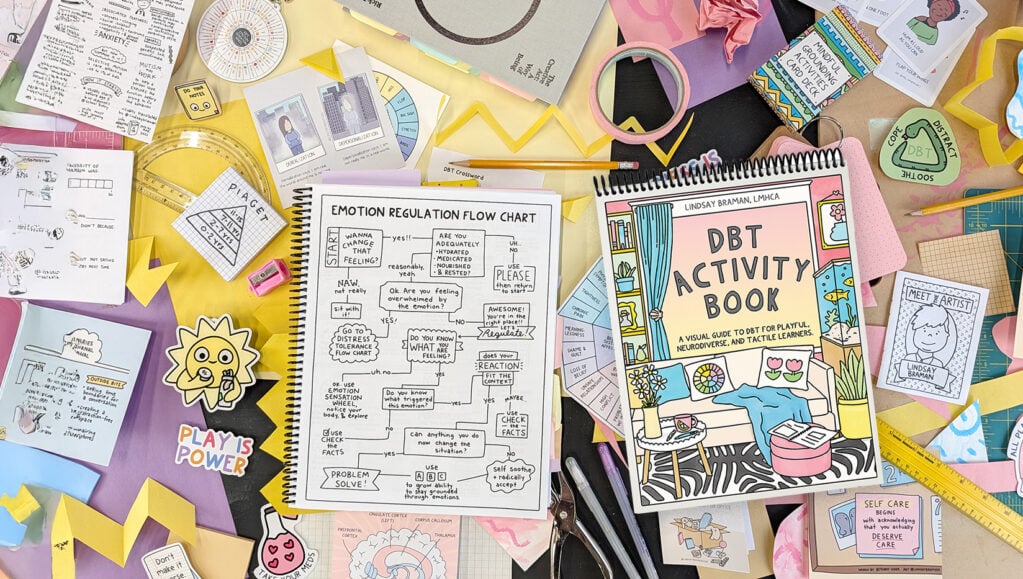
Fun Flowcharts: Standard DBT resources prescribe “do this when you feel ___”but my interactive flow charts empower users to explore various paths and plan which DBT skills to use in a choose-their-own-adventure format.
Less Clinical Crisis Resources: Over 100,000 people have downloaded my approachable take on a crisis plan. The DBT Activity Workbook includes a version specifically adapted for DBT users.
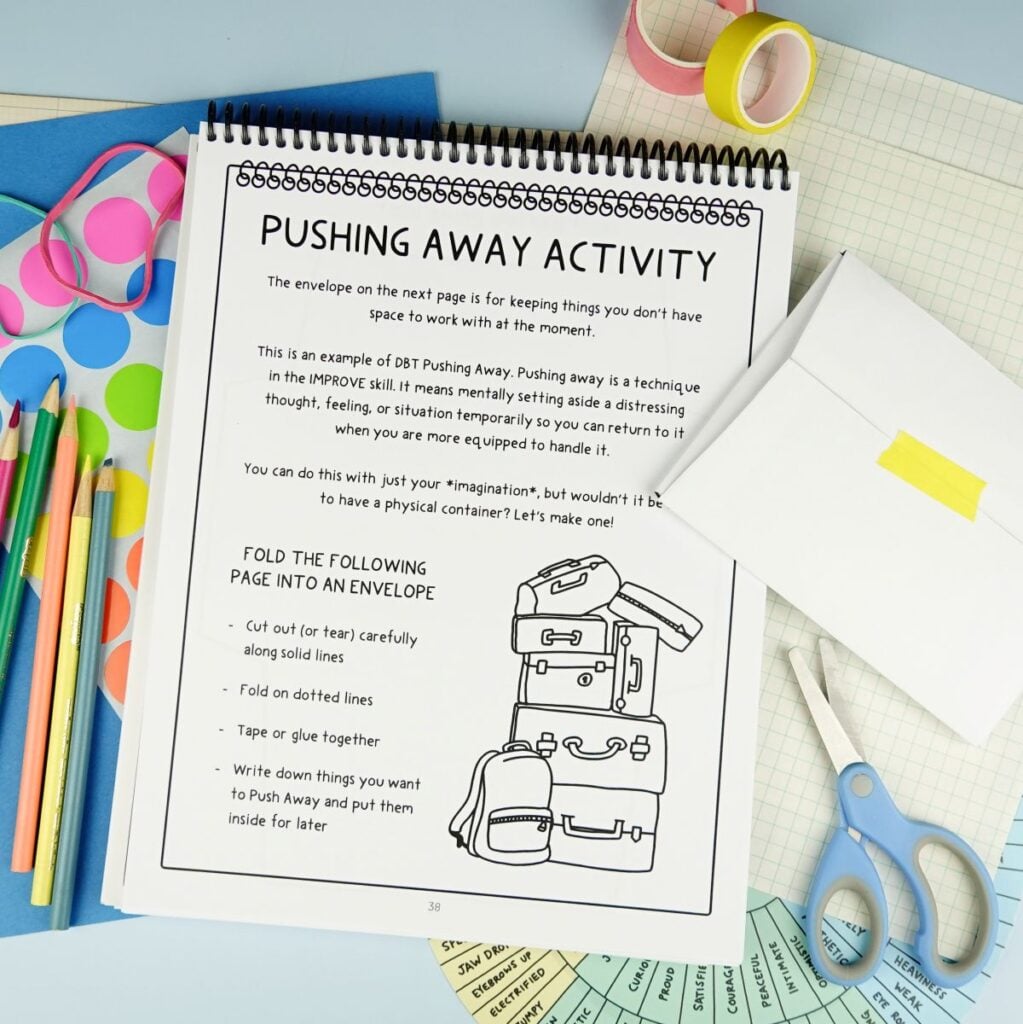
Cut and Paste Activities: Get your scissors and glue sticks ready, because learning TIPP, PLEASE, and Pushing Away through my lens will involve cutting along the dotted lines!
For many of us, the typical stack of Dialectical Behavior Therapy worksheets in a generic white binder is- at best- BORING, and at worst, pretty dang triggering.
This book was created to change that – to subvert our internal scripts about worksheets, clinical resources, and studying – and instead invite us to explore, imagine, play- and absorb a whole lot of DBT skills in the process.
Who is Lindsay Braman and why did she make a DBT book?
I’m a trained therapist and a visual artist with art in the collection of the Museum of Modern Art. But before I was any of those things, I was a person who struggled to learn via traditional learning materials.
I call myself a visual translator because that’s what I was doing long before I had letters after my name: turning words and ideas into vibrant visuals so they fit into my neurodivergent brain.
I create at the intersection of art, theory, research-backed data and, well, cuteness. But don’t be fooled by soft lines and a touch of adorableness – being playful is subversive – and it seriously works to activate different parts of our brain in the process of learning, growing, and healing.
Why I Made a DBT Book for Neurodivergent and Visual Learners
If you’ve ever picked up a DBT workbook or glanced at clinical‑looking worksheets and immediately felt yourself zone out, this activity book is for you.
Learning works best when it’s active, emotional, and a little bit playful – and this book is built for that. Through repetition, imagination, and visual engagement, it supports how our brains naturally grow new habits.
Here’s the thing: Dialectical Behavior Therapy (DBT) is one of the most widely researched forms of therapy for helping people build emotional regulation, distress tolerance, interpersonal effectiveness, and mindfulness skills that truly work in everyday life. There’s a massive body of research demonstrating that DBT reduces self‑harm behaviors and emotional dysregulation while improving quality of life. 1 But traditional DBT worksheets (especially dense, left-brain designed ones) can feel like busywork. That’s where this book comes in: it deeply honors the evidence-based science of DBT without oversimplifying.
Its a Tool to Help Brains Access DBT Skills in High Intensity Moments
Reading activates the left side of the brain, but the kind of high-intensity situations where we need DBT skills the most are right-brain-activating emotional situations. How can we bridge the gap? Mostly, through practice and using skills in real life. But practically, we can boost recall by learning DBT through more creative, whole-brain activities (like play combined with reading, drawing, and playing.)
Which is a good segue into the theory behind this format:
Research supporting learning DBT in a visual format:
Ok, if you don’t love a deep dive into research, here’s the key takeaways here:
- Research shows that activating multiple brain systems (e.g., visual + motor + semantic) forms a stronger memory trace. 2
- A memory trace is the cellular changes that occur in the brain when we learn something. And our brains are very good at making them.
- Traditional workbooks engage logical thinking to teach emotional concepts, this may make recall in very emotional moments harder. 3
- This section connects general learning science to the design choices behind the DBT Activity Book.
Whole brain learning, that involves creative tasks, likely creates memory traces in regions of the brain that are activated during high intensity emotional experiences where DBT skills are most needed. While researchers haven’t explored this specific question yet, it is a likely outcome based on previously established science.The research is abundantly clear that, for some symptom constellations, DBT is the most effective treatment, 4 5 but let’s talk about the research supporting learning DBT in an activity book format instead of a workbook.
I’ve spent years following research on how and why visual learning seems to be so effective so so many people. Here’s what I’ve learned:
Brains are evolutionarily designed to remember important stuff: Whether it’s remembering the location of a foraging source or how to recognize signs a sabretooth tiger was near, memory has been one of the most important tasks of a brain for all of human history. 6 Because of that, brains evolved to have lots of redundancy in the process of forming a memory.
Brains use more than one region to form, store, and recall memories. Modern neuroscience has demonstrated that multiple areas of the brain are involved in the formation of new memories 7.
Being purposeful about activating more parts of the brain while learning can help us remember better 8, 9
Drawing, doodling, coloring, and completing non-text-based tasks helps us remember better than reading alone. 9 Research on how brains learn gets complex very fast, but the simplest takeaway is this: Language-based information like words mostly engages the left brain, while visual information engages the right brain. 3
More about how the DBT Book is Different than Typical DBT Resources
A plain white 3-ring binder with low-res photocopies of DBT worksheets is so standard in inpatient, partial hospitalization, intensive outpatient, and DBT groups that it’s reached meme status on social media:
https://www.tiktok.com/@ghost_cherry_/video/7530062578463165710
But what if there was a better option? Something that got buy-in from reluctant readers by helping DBT skills look as good as we in the field know they are when used?
Therapists know DBT is a potent tool to decrease suffering and even save lives – but we don’t do a great job packaging the skills in a believable way. The DBT Activity Book Changes that.
The truth is, that for most people who complete an inpatient or IOP program, that white binder doesn’t last long. The institutional binding and clinical looking worksheets don’t usually get revisited – often, it sits on a bookshelf as a cold reminder of a very painful chapter in someone’s life.
The DBT Activity Book flips this script: A cute cover, professional binding, and interactive pages frame a very different version of those familiar DBT resources.
By using cuteness, color, and play to subvert the internal voice that might avoid clinical-looking resources, we can help the people we care about have accessibility to learning DBT in a format that works for them.
Instead of dry worksheets, this activity book reimagines DBT skills through doodle‑style diagrams, interactive prompts, and visual storytelling. Every page is designed to engage more of your brain rather than just your eyes reading text.
Accessibility isn’t an afterthought in this book – it’s the starting point.
The DBT Activity Book was designed for brains that struggle to take in dense text, rigid formats, or anything that looks too clinical and feels pathologizing.
Many neurodivergent people (including folks with ADHD, autism, learning differences, and acquired neurodivergence through PTSD or chronic stress) process information more effectively when it’s visual, tactile, and interactive.
But make no mistake. Nothing is dumbed down, and this isn’t a resource aimed at kids or teens. I like to say that the resources I create are “distilled.” No fluff, no filler, just down to earth language. I specialize in understanding the technical language behind research in social sciences and translating key ideas into ordinary communication.
This book meets the needs of neurodivergent users in multiple ways:
- drawing instead of writing,
- choosing paths instead of following a linear worksheet,
- avoiding clinical language,
- and aiming for curiosity rather than compliance.
- Every page is built to reduce overwhelm, support nervous system safety to keep users in their Window of Tolerance, and honor the reality that learning – like healing – isn’t linear.
- It’s flexible: Each activity stands alone, so you can use it in therapy, on the couch with your markers, or in DBT groups without worrying about a strict order.
Who the DBT Book Is For
& who might benefit from a different tool
It’s for you if:
Probably not for you if:
What People are Saying:
Why Learning DBT Through Play Works So Well
You might wonder: “Is this just cute, or is there science behind it?” The answer is: both. And the key to integration is in 3 parts:
1. DBT Is Evidence‑Based
DBT is one of the most thoroughly researched therapy models. It significantly reduces self‑harm and suicidal behavior in people with borderline personality disorder (BPD), as well as improving emotional stability and quality of life. 11 But DBT isn’t just for people with BPD; it’s demonstrated by research to be helpful for many people with depression, bipolar disorder, 12 , 13 and even eating disorders (although a spin-off version of DBT, RO-DBT, tends to be significantly more helpful for people with restrictive eating disorders) 14 Unlike most DBT workbooks, the DBT Activity Book actually covers RO-DBT and offers a sketchnote about when to seek RO-DBT instead of DBT therapy.
By teaching skills to tolerate discomfort and improve emotional regulation, DBT can be a key tool for stabilizing and reducing the intensity of symptoms.
2. Visual Learning Helps Concepts Stick
Research consistently shows that participating in the creation of visuals – like images, flowcharts, and diagrams – helps people learn and remember more effectively than text alone. 15 Drawing likely helps us remember because it engages multiple cognitive processes – visual, semantic, sensory, and motor – creating a stronger memory trace. 16
Content on this site is for educational purposes and does not replace mental health treatment. See site Terms of Use for more information.
A memory trace is the physical change that happens in our brain when we form a memory. Memory traces form when connections between neurons strengthen – the more we practice (and the more ways we practice) the stronger those connections get, making it easier to remember later.
3. Making Learning Active Matters
When we’re in the middle of feeling a lot of emotions, our brain is mostly activated in regions associated with emotion, alertness, and threat response. DBT skills are designed to be used in these exact situations, but the way standard DBT is taught primarily activates the logical, verbal, reasoning part of our brain.
This disconnect may actually make it harder to access and use DBT skills in the heat of a high-emotion moment. With practice, many DBT learners are able to successfully bring these skills into emotional or high-conflict moments – but what if it could be a little easier?
Learning through creative methods that engage both the thinking and feeling brains – like drawing, playing, and creative engagement may help build stronger, more flexible memory traces that are more accessible during a range of emotion-states. Right-brain-friendly learning approaches may stick with us better under stress, making it a little easier and a little faster to start using DBT skills in real-life moments of high emotion.
I believe this is true for nearly all learners – but especially for neurodivergent folks like me.
Why Learn DBT Through Play?
When I was creating and testing these pages with my Patreon community of several thousand therapists and people on their own healing journey, the feedback I heard over and over again was a sort of sigh of relief: not because the worksheets in my book made Dialectical Behavior Therapy skills easy, but because they felt more accessible.
Play isn’t frivolous. It’s a legitimate mode of learning.
When we approach tough stuff like learning new skills for Emotion Regulation or Urge Surfing with curiosity, creativity, and color, we activate parts of the brain that help memories form more solidly and make skills feel more accessible.
Where to Get the DBT Activity Book
If this sounds like your kind of resource, you can find the DBT Activity Book in my shop. Some readers use it alongside their therapy, others curl up with it at home with markers and tea, and some facilitators bring it into DBT group therapy activities as a fresh tool for outpatient, IOP (intensive outpatient), or PHP (partial hospitalization programs).
I also offer extras, like printable pages and digital versions, for folks who love DBT worksheet PDF versions they can use on-the-go.
FAQ:
Wrapping Up: the tl;dr on the DBT Activity Book
Was this article a little overwhelming to skim? I get it. That’s why I made the book! SO, here’s a kinda visual shortcut to the most important stuff in this article:
✅ It covers all four DBT modules.
🎯 The book includes at least one activity for every major/standard DBT skill.
🌀 It reimagines core DBT content as doodles, flow charts, wheels, and activity pages.
🧠 It’s designed to support neurotypical and neurodivergent learning through creativity and interaction.
Buy a copy today by:
Artist preferred: – Buy from my store (free shipping within the USA!)
Best for urgent orders: Order from Amazon through this affiliate link
Or ask your local bookstore to stock the DBT activity Book by ordering directly from me or through my wholesale shop on Faire.
Explore More DBT Products I’ve Created:
- Panos, P. T., Jackson, J. W., Hasan, O., & Panos, A. (2014). Meta-Analysis and Systematic Review Assessing the Efficacy of Dialectical Behavior Therapy (DBT). Research on Social Work Practice, 24(2), 213-223 [↩]
- Dando, C. J. (2013). PloS one, 8(7), e69937. [↩]
- Schacter, D. L. (2002). United States: Houghton Mifflin Harcourt. pg 26-27 [↩][↩]
- Panos, P. T., Jackson, J. W., Hasan, O., & Panos, A. (2014). Meta-Analysis and Systematic Review Assessing the Efficacy of Dialectical Behavior Therapy (DBT).Research on Social Work Practice, 24(2), 213-223 [↩]
- Kothgassner OD, Goreis A, Robinson K, Huscsava MM, Schmahl C, Plener PL. Efficacy of dialectical behavior therapy for adolescent self-harm and suicidal ideation: a systematic review and meta-analysis. Psychol Med. 2021 May;51(7):1057-1067. doi: 10.1017/S0033291721001355. Epub 2021 Apr 20. PMID: 33875025; PMCID: PMC8188531. [↩]
- Bisaz, R., Travaglia, A., & Alberini, C. M. (2014).. Psychopathology, 47(6), 347-356. [↩]
- Robertson, L. T. (2002).. Journal of dental education, 66(1), 30-42. [↩]
- Zivan, M., Vaknin, S., Peleg, N., Ackerman, R., & Horowitz-Kraus, T. (2023).. Plos one, 18(5), e0283863. [↩]
- Dando, C. J. (2013). PloS one, 8(7), e69937. [↩][↩]
- This book is an educational resource, not a substitute for professional mental health treatment. While the activities are grounded in evidence-based DBT principles, they are meant to support learning and practice- and not intended to replace working with a qualified clinician when that level of care is needed. If you’re in crisis or need immediate support, please reach out to a licensed professional or local emergency resources. [↩]
- Jones, B.D.M., Umer, M., Kittur, M.E. et al. A systematic review on the effectiveness of dialectical behavior therapy for improving mood symptoms in bipolar disorders. Int J Bipolar Disord 11, 6 (2023). [↩]
- Yale Medicine. (2025). Dialectical behavior therapy (DBT). Yale Medicine. [↩]
- Cleveland Clinic. (2022, April 19). Dialectical behavior therapy (DBT). Cleveland Clinic. [↩]
- Chapman AL. Dialectical behavior therapy: current indications and unique elements. Psychiatry (Edgmont). 2006 Sep;3(9):62-8. PMID: 20975829; PMCID: PMC2963469. [↩]
- Meade, M. E., Wammes, J. D., & Fernandes, M. A. (2018). Drawing as an Encoding Tool: Memorial Benefits in Younger and Older Adults. Experimental Aging Research, 44(5), 369–96. [↩]
- Herrera, T. (2019, January 6). A simple way to better remember things: Draw a picture. The New York Times. [↩]