Making Friends as an Adult
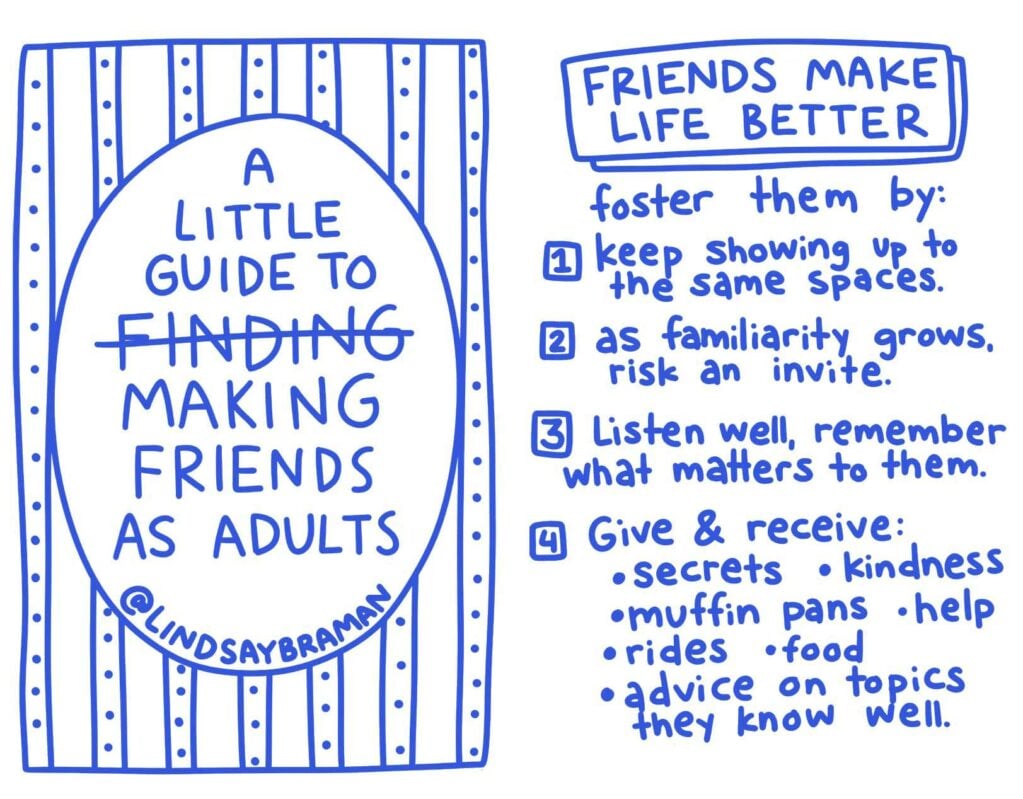
This illustrated little zine summarizes research on how to grow skills for making new friends as an adult.
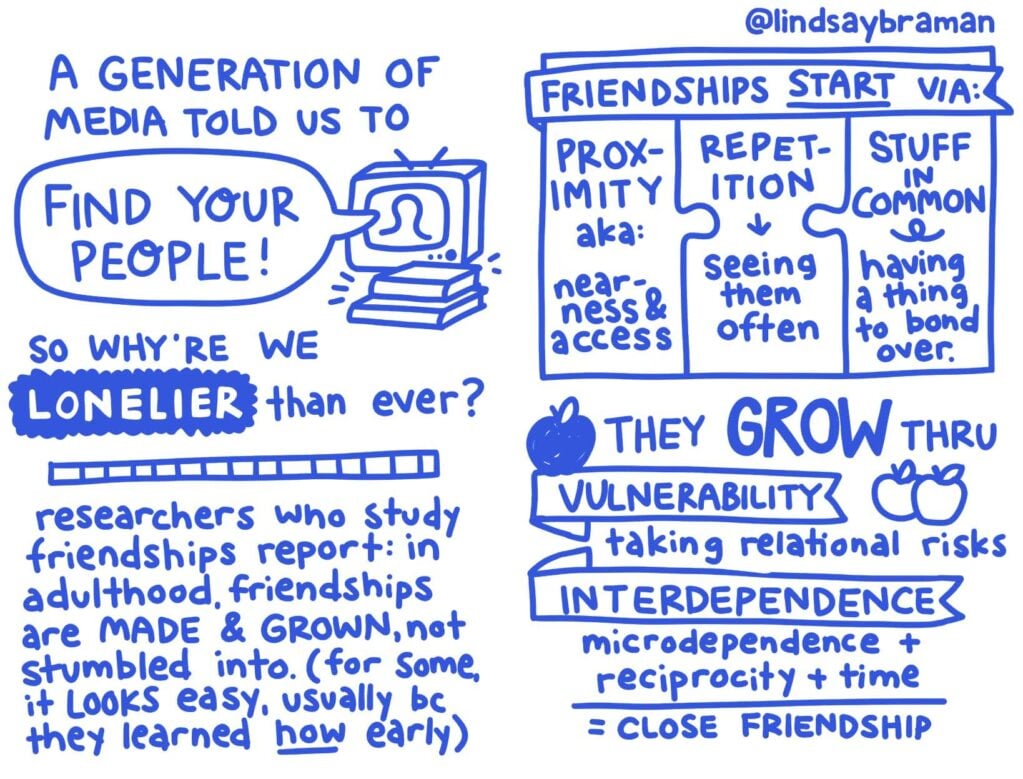
For most of my life, I’ve heard some version of the advice to “find your people” repeated through TV, books, and social posts. This idea that someone pitched and we all kind of swallowed whole: somewhere out there are people who will really “get” us, love us, and make us feel like we belong. We just have to “find them.”
But what if that advice sent us running in the wrong direction? What if looking for the elusive friend group that will “get” us, without us learning and practicing the skills required for a relationship, is part of the increase in reported feelings of loneliness? 1 What if, instead of finding our people, making friends as adults is about creating the conditions for friendship, and then investing with vulnerability in growing relationships?
That’s the idea being supported by some researchers who study friendships. In my illustrated zine, A Little Guide to Making Friends as Adults, I explain what friendship researchers have learned about the process by which strangers become close friends, and how we can use that information to build more meaningful connections in our own lives.
Friendship is a skillset. It isn’tsomething that just happens when we stumble across the right people. The kind of friendships we want grow through a series of small interactions, shared experiences, and increasing vulnerability over time that gradually builds trust.
Why making friends as an adult is so hard
If it feels like it was easier to make friends as a child or teen, you’re right!
Most kids have built-in opportunities to make friends. We spent hours in classrooms together, played with the same kids at recess, and saw familiar faces at after-school activities. We felt feelings more openly, and we displayed vulnerability in how we, through the natural process of growing up, experimented with identity and interests. Without even putting in effort, the conditions were set for deep friendships to develop.
As adults, that perfect setup tends to disappear. Even when we meet someone we really like, we may not have a natural reason to see them again. We might make “work friends” easily, but these relationships often end when we’re transferred or change jobs – which workers do with increasing frequency. 2
In a now-classic New York Times article, 3 Alex Williams explored why making friends after 30 can feel so difficult. Encountering this article a decade ago is what piqued my interest in friendship as a skill – and that interest is probably part of the crazy-from-the-outside life that I’ve built around my art studio in St. Louis*.
As we get older, the opportunities for repeated, unplanned contact become less accidental and begin to require more effort or planning But it’s complicated, right? If we grew up accidentally finding friends and being told new friendships were a matter of being found, we might not go looking – and research says intention is exactly what forms friendships in adulthood.
And 2020-2021 were tough years for friendship. A 2021 national survey found that 12% of Americans reported having no close friends, compared to 3% in a 1990 survey. Nearly half reported having three or fewer close friends. 4
The good news is that making friends involves skills we can learn and practice, EVEN if we didn’t get much practice growing up.
Some people seem to make friends effortlessly. While personality and privilege play a role, some of what looks like natural social talent may actually be a set of relationship skills they’ve practiced – maybe without even knowing – for years. If you grew up in a home where parents modeled putting effort into relationships, supporting and listening well, and sharing with appropriate vulnerability, you might have been mentored into being a master-friend-maker without even knowing. Others of us have to learn skills the old-fashioned way: similar to how DBT Therapy works, we learn what the skills are, we practice the skills, and with enough practice the skills begin coming more naturally.
See the digital version of my zine!
The three ingredients that help friendships begin
You can purchase a folded version or you can print and fold at home!
The download includes:
- zine folding instructions
- a zine to print and fold
- The art arranged in comic format- print and use without folding!
What makes strangers into friends?
If we’re focused on trying to find the perfect people, we might miss the people already loosely in our orbit – and researchers say that’s exactly where, statistically, friends are found.
1. Proximity: Being near each other
Proximity simply means being near to someone. Think of it like how you met your childhood best friend: lots of people met their childhood best friend because they lived a few houses away or sat nearby in school. I met one of my best childhood friends because our mothers had beds close to each other in the hospital’s maternity ward!
We didn’t choose those people because they were a perfect match for our personality. We became friends because we were around each other, became familiar, shared vulnerable moments, and enjoyed each other.
As adults, proximity can be harder to find – especially in the suburbs and rural areas. (Interestingly, in small towns and dense cities, many people report this being a little easier.)
You can create proximity to potential future friends by trying out some meetups, clubs, volunteer groups, spiritual gatherings, workout classes, or creative/art classes, and then- after you’ve sussed out whether they’re your vibe – committing to attending regularly for a few months.

people at an outdoor event.
The commitment part is really important in the beginning – and it’s the hardest part. It might help to attend groups with programming (like a class or religious service), a shared activity (like volunteering or sports), or something to do with your hands (like a fiber arts club or painting class). I often bring my dog to outdoor events!
The goal isn’t to immediately find ourselves a best friend. It’s to put ourselves in spaces where friendship has a chance to begin. That’s proximity.
2. Repetition: Seeing each other again and again
Proximity helps us meet people, but repetition helps us get to know each other.
Our brains are wired so that when we see someone regularly, we begin to recognize them. We move from recognizing a familiar face to being someone we greet, then someone we might chat with for a bit. Over time, it’s small interactions that can create the foundation for friendship.
This is one reason why attending a single event with the goal of making friends can feel so discouraging. We might have a wonderful conversation with someone, but if we never see them again, the relationship may not have a chance to grow.
Researchers at the University of Kansas found that the amount of time people spent together was linked to how close their friendships became. (Spoiler, “Casual friendships emerge around 30 hours, followed by friendships around 50 hours.” ) 5
In other words, showing up once is a start. Showing up again and again (and again) is where actual friendship begins to grow.
3. Stuff in common: Having something to bond over
“Researchers debate what comes next: similarity is often named, but shared activities and mutual, gradually deepening self-disclosure can also help friendships grow.”6 But I think “stuff in common” kind of sums them all up: It gives us something to talk about and something to do together while we’re building a friendship.
We don’t need to have identical personalities, hobbies, or life experiences to become friends. But having something in common makes those first conversations easier.
Sometimes, the thing we have in common is simply the experience of being in the same place! As a regular at my neighborhood dog park, I now have friends in my orbit that I’d neeeeeeever in a million years have connected with if we weren’t spending a half-hour together most evenings, talking about dogs.
The key mindset shift:
Instead of asking, “When will I find my people?” we can ask, “Where can I keep showing up, seeing the same people, and getting to know them in a fun environment?”
How strangers become close friends
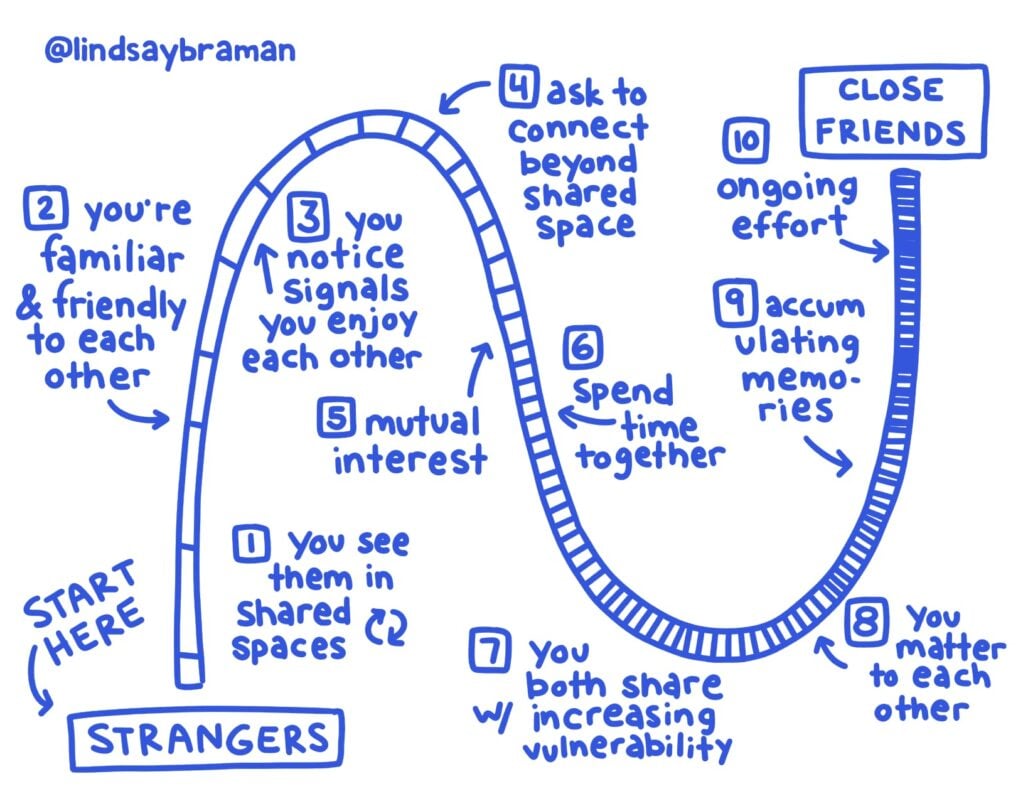
One of the things I wanted to illustrate in my zine is that friendship usually develops through a series of small steps.
The path from strangers to friends
Every friendship is a little different, but here are the common steps along the way:
- We see each other in shared spaces. We’re coworkers, classmates, neighbors, etc.
- We become familiar and friendly. We recognize each other, say hello, and maybe chat.
- We notice signs of mutual interest. Conversations become easier, we laugh together. We might notice being glad to see them.
- Someone takes a small risk. One of us suggests getting coffee, exchanging phone numbers, or spending time together outside the shared space.
- The interest is mutual. The other person said yes!
- We spend time together. We shared experiences and learn more about each other.
- We gradually become more vulnerable. We begin sharing things that matter to us, and the other person responds in a supportive way.
- We start to matter to each other. We notice when the other person is quiet or absent, remember the names of people they care about, and show up for them – and they us.
- We accumulate memories. We have inside jokes, we have stories we tell about shared experiences, and we work through ruptures and conflicts because we value the other person.
- We continue making an effort. Both people invest in maintaining the relationship over time, even though it’s sometimes inconvenient or goes through seasons of being unequally supportive.
These steps leave out two important pieces that I include when we’re talking about growing friendships: vulnerability and interdependence.
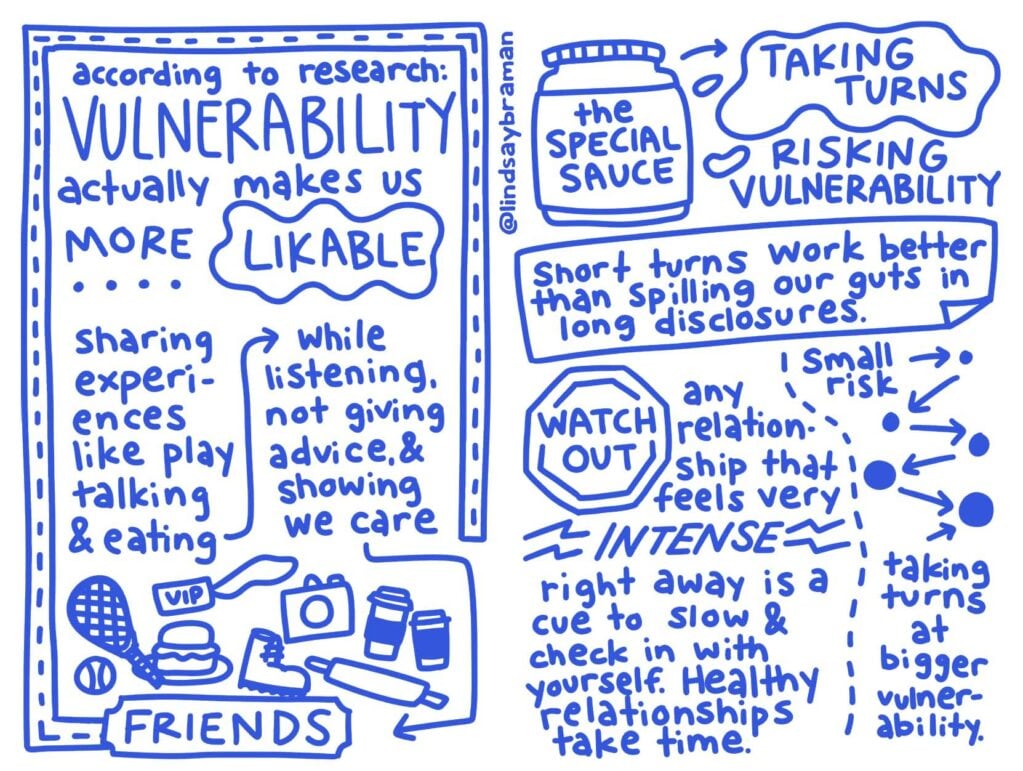
Vulnerability helps friendships grow
Once we’ve established familiarity and mutual interest, something else becomes important: vulnerability.
Vulnerability means taking risks in allowing another person to see something real about us, even when we aren’t sure what they’ll think.
It might mean admitting that we’re nervous about a dentist appointment, sharing that we’re feeling confused about how to deal with something at work, or even the vulnerability of showing up without a pretense (this can show up in showing up with a lot of bravado in physical ways or as simple as letting them see us au naturale on a day we chose not to spend time getting ready) and accepting that they’ll still like us.
These small moments of openness invite another person to know us more deeply. And it makes people like us MORE. 7
When we’re hungry for connection or have overwhelming fears of eventual rejection, it can be tempting to share a lot of personal information with someone who seems interested in listening. Vulnerability works best when it’s mutual. Someone has to take the first step, but it’s best to take turns taking steps forward (like dancing!) vs. running down the trail by sharing a whole lot very quickly.
A note of caution: Relationships that feel extremely intense right away can be a cue to slow down and check in with ourselves. Intensity isn’t always a sign that something is wrong, but it can be a red flag. Safe, healthy relationships take time to grow.
Interdependence turns friendship into something more
Something I think gets skipped sometimes when we’re talking about friendship in the modern era is interdependence. That’s a big word for a pretty simple idea: We begin to rely on each other in real ways.
When we think about depending on another person, we might imagine needing help during a major crisis. But friendship often grows through much smaller exchanges: humans have a long (I mean long) history of building relationships by giving from our excess resources and receiving support when we’re in need.
Interdependence might look like:
- Borrowing a muffin pan and returning it (maybe with a few muffins!).
- Asking a friend for a ride to a medical appointment and letting them help.
- Sharing food, books, tools, or craft supplies.
- Asking for advice about something a friend knows well (especially when it comes to their expertise based on lived experience. Asking a real human expert instead of AI can build relationships.)
- Trusting someone with a small secret and respecting the things they share with us.
These exchanges matter because they create opportunities to experience each other as dependable and able to meet some of each other’s needs – which is, really, what friendship is about.
When a friend asks us for help, we get an opportunity to show that we care. When we ask for help, we give them an opportunity to show up for us. We grow more connected, more supported, and, I think, in a way, more independent because we have a safety net that supports us as we experiment with living out our true selves.
Of course, reciprocity doesn’t mean keeping score. I grew up learning that “you have to be a friend to have a friend,” but growing healthier relationships in adulthood has meant understanding that “getting the score back to balanced” isn’t the goal of a good friendship.
A little guide to making friends as adults: My illustrated zine
I made A Little Guide to Making Friends as Adults because I wanted to turn all this thinking and research into something we can actually use.
My illustrated zine breaks down the process of making friends into small, understandable steps for adults. (Because, let’s be honest, making friends as a middle or high schooler has some distinct social challenges that I need to make another zine for!) It explains how friendships begin through proximity, repetition, and shared interests, and how they grow through vulnerability, reciprocity, and time.
My hope is that it can serve as a little reminder that friendship is something we can practice, experiment with, and grow skills for getting better at.
If you’re trying to make new friends, rebuild your social life, or support someone who is feeling lonely, I hope this little guide offers a place to start.
An illustrated resource
Get the friendship zine
You can get A Little Guide to Making Friends as Adults in my shop, or access it along with my other illustrated resources by joining my Patreon for $6/month.
- Buecker, S., Mund, M., Chwastek, S., Sostmann, M., & Luhmann, M. (2021). Is loneliness in emerging adults increasing over time? A preregistered cross-temporal meta-analysis and systematic review. Psychological Bulletin, 147(8), 787–805. https://doi.org/10.1037/bul0000332 [↩]
- Schinoff, B. S., Pillemer, J., Rogers, K. M., & Petriglieri, J. L. (2025). Blurring boundaries in coworker relationships: How a nonwork setting becomes a relational holding environment. Organization Science, 36(6), 2061–2086. https://doi.org/10.1287/orsc.2022.17130 [↩]
- Williams, A. (2012, July 13). Why is it hard to make friends over 30? The New York Times. https://www.nytimes.com/2012/07/15/fashion/the-challenge-of-making-friends-as-an-adult.html[↩]
- Cox, D. A. (2021, June 8). The state of American friendship: Change, challenges, and loss. Survey Center on American Life. https://www.americansurveycenter.org/research/the-state-of-american-friendship-change-challenges-and-loss/[↩]
- Hall, J. A. (2019). How many hours does it take to make a friend? Journal of Social and Personal Relationships, 36(4), 1278–1296. https://doi.org/10.1177/0265407518761225[↩]
- Fehr, B. (2009). Friendship formation and development. In H. T. Reis & S. K. Sprecher (Eds.), Encyclopedia of human relationships. SAGE Publications. https://doi.org/10.4135/9781412958479.n227 [↩]
- Aron, A., Melinat, E., Aron, E. N., Vallone, R. D., & Bator, R. J. (1997). The experimental generation of interpersonal closeness: A procedure and some preliminary findings. Personality and Social Psychology Bulletin, 23(4), 363–377. https://doi.org/10.1177/0146167297234003[↩]