Ghosted by a Therapist Comic: Therapy, Attachment Anxiety, & Ghosting
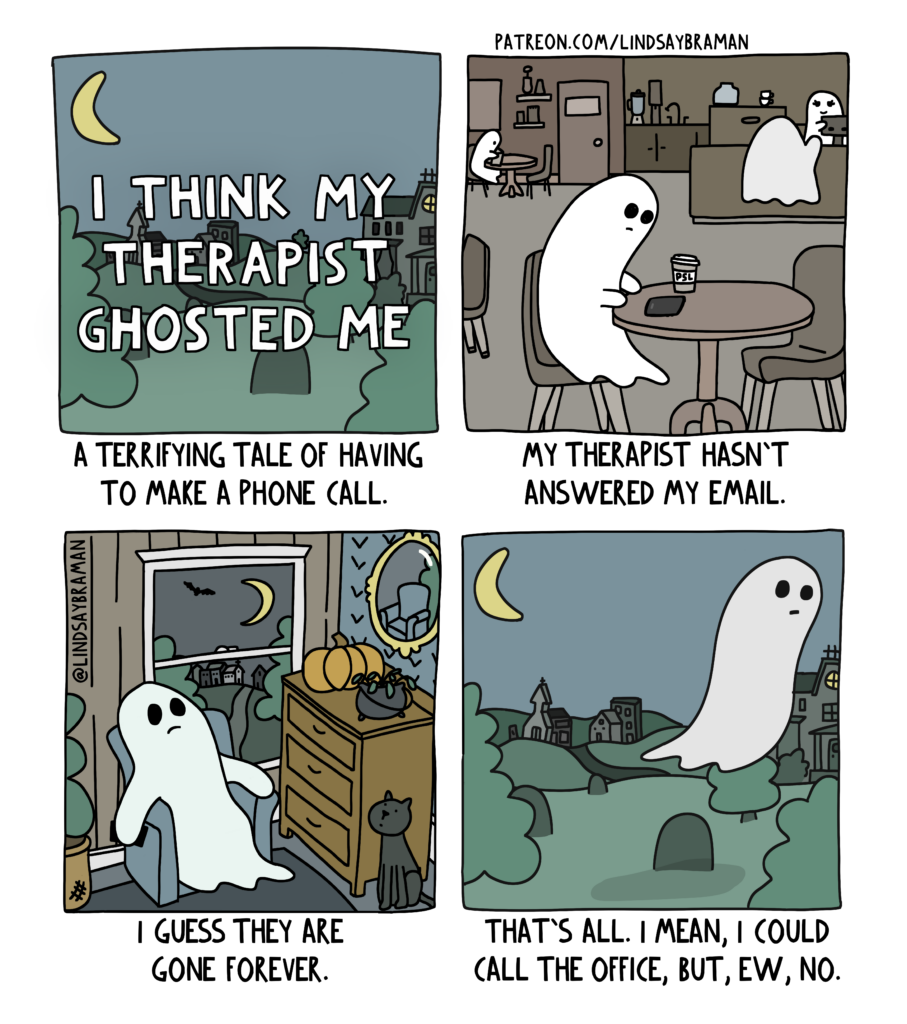
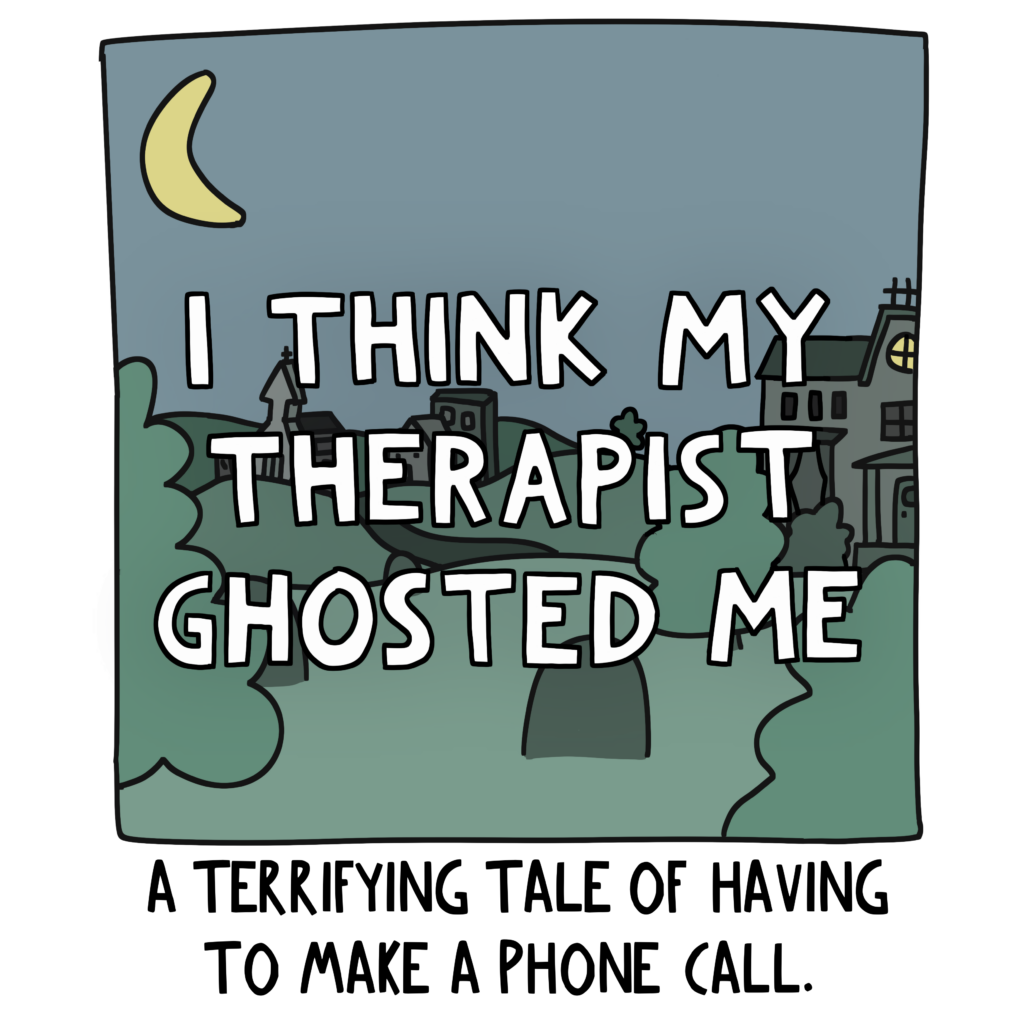
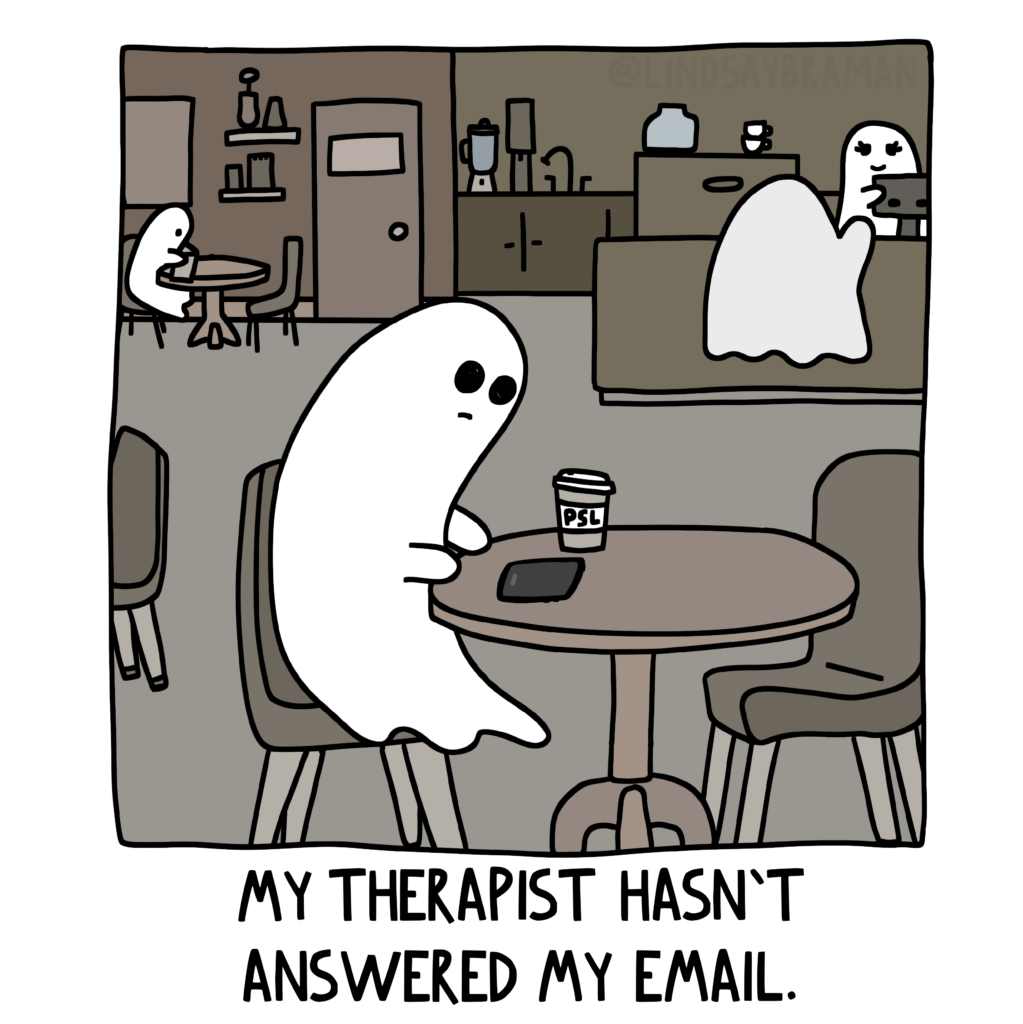
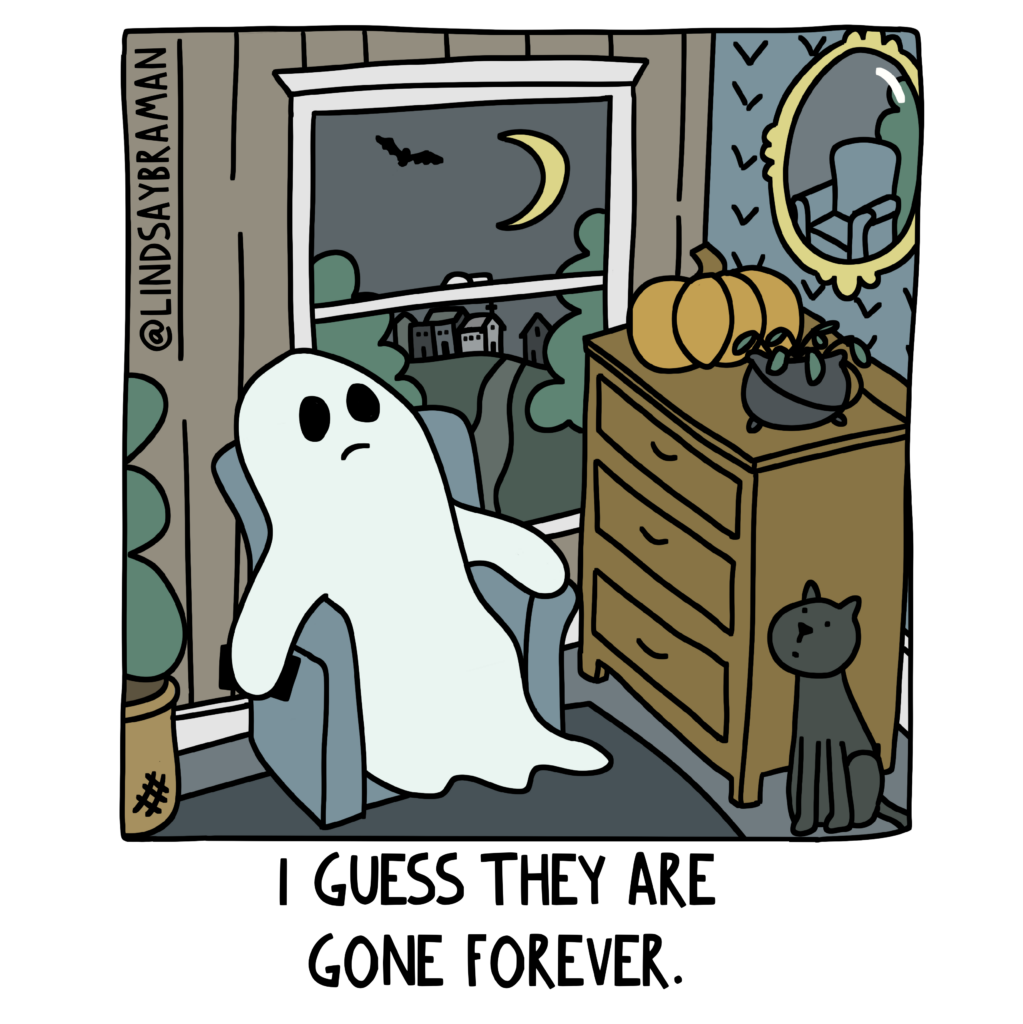
In this illustration, a sad little ghost goes about his day convinced that, because his email has not received a response, he is doomed to abandonment…
About the Comic:
This simple little psychology cartoon offers a playful way of engaging of two things that many of us struggle with: anticipating rejection and the terror of communicating our needs.
What Ghosting Is, and How it Shows Up in Therapy
Ghosting is: “Terminating communication with another person without explanation.” 1 It’s a form of cutoff or estrangement, but without communication about an intentional ending.
In today’s always-online world, waiting hours or days to hear back from a therapist can feel like being ghosted. If we also we have anxiety about abandonment, a temporary silence from an attachment figure can feel like abandonment.
When clients ghosts therapists, on the other hand, this choice is usually motivated by a need to avoid the discomfort of difficult conversations. 2 3.
This article explores ghosting and therapy as it shows up in three potential ways:
- Fear of Abandonment (the subject of this psychology comic)
- When a therapist actually ghosts a client (called “client abandonment” in the field.)
- When clients ghost their therapists.
Fears of Being Ghosted by a Therapist.
Some therapists have abandoned clients with no notice- even though its against ethics code. This reality coupled with the fact that many of us have experienced attachment trauma combine to create what can feel like a very legitimate fear of being ghosted by a therapist.
All relationships that involve attachment involve vulnerability to abandonment. Because psychotherapy and counseling activate attachment, it’s common for clients to worry that they may become victims of a therapist ghosting them.
What counts as a therapist ghosting:
The ethical code therapists agree to work under when they become professionals specifically prohibits client abandonment. It’s important to note here that termination and abandonment are not the same thing 4 .
A therapist is not allowed to ignore phone calls/emails and stop showing up to appointments. However, just like a client, a therapist can choose to initiate the termination process.
The difference between termination and abandonment is that during an ethical termination process, the therapist will provide notification of an intent to terminate sessions at a future point, provide at least one conversation that allows space for processing this information, and should provide referrals to other providers during the termination process.
Allowing therapists to be human
While therapists aren’t allowed to ghost us, they are – of course – allowed to be human. All humans make mistakes, and most humans experiencing the daily onslaught of information that all of us experience in present-day life can miss messages, fall behind, and fail to return messages.
If you suspect your therapist may have ghosted you, you can do the following instead of suffering like our cartoon ghost friend:
- Have a conversation with yourself about that thought. Is it fear-based? Is it prompted by an experience you’ve had in the past? Or is it a reasonable assessment of the situation? Who do you know your therapist to be based on how they have spoken to and treated you in the past?
- Put yourself out there and make another attempt at communication. This will look different based on the channels you have to communicate with your therapist. If you’re not getting a response, though, it’s often a good idea to reach out through another channel. If you have already emailed, call and leave a voicemail. If you used a secure messaging portal, try reaching out to the clinic’s front desk. Sometimes, tech just doesn’t work. Reaching out through an alternate communication form can circumvent an email lockout or phone contact reset.
When Therapists Ghost Clients – a.k.a. Client Abandonment.
It’s rare, but therapists are reported to licensing boards each year for client abandonment. It might be tempting (or previous-experience-confirming) to suspect that being ghosted by a therapist is about us or our therapist’s dislike of us 5. However, people who work in the field of mental health are particularly vulnerable to burnout 6, and it’s far more likely that a client abandonment is due to health, mental health, or other urgent problems.
Signs that your therapist has abandoned or ghosted you:
- Scheduled sessions have been missed or canceled with no explanation or option to reschedule.
- Multiple attempts to reach them, through multiple forms of communication, have gone unanswered.
- More than two normal appointments have been missed, or the communication gap has spanned that long. (For example, if you meet every other week and it’s been a month since you have communicated with them.)
- In your previous session, you did not make a statement expressing a desire to end therapy. (Even if you meant this as a joke or later changed your mind, the lack of communication may be out of a perceived desire to respect your choice. Resolution may come through attempting to clarify this.)
What to do next if your therapist has ghosted you
In the case of client abandonment, the client has the right to make a report to the counselor’s licensing board. However, as with most relationship conflicts, it’s better to try and resolve the issue directly, first, and to also let a bit of time pass to be able to make the report with a clear mind.
If your therapist has behaved towards you in a way that constitutes abandonment, the next steps are:
- Reach out, one more time. Even though attempts to reach out previously failed, send them a message – perhaps by mail if all other routes of communication have failed – to let them know that you feel that you have experienced abandonment by them. Even if you still get no response, some closure may come through speaking your truth.
- Wait a few weeks. Waiting a few weeks before filing a report to the licensing board will give you a chance to file a more objective report, which may help the report be taken more seriously. Waiting also gives the therapist an opportunity to respond. While all therapists should have a professional will and a professional executor who notifies their clients in the event of an emergency, it is possible that your therapist experienced a medical or mental health crisis. When therapists do not have professional executors, this information can take longer to reach clients.
- File a report. Research the steps to reporting a therapist in your state. In the United States, therapists and counselors are licensed at the state level, often by the Department of Health. Instructions for filing an ethics violation report should be published somewhere within your state Department of Health’s website.
- Process and heal. Even though being truly ghosted by a therapist may leave you determined to never trust another mental health provider, it’s important to give yourself space to process the trauma. For many people, this means establishing care with a new therapist. However, you may find support through other avenues like support groups, spiritual communities, or similar places where you can share your experience and receive support.

Ghosting A Therapist: When Leaving Feels Easier than Conflict Resolution.
Many of us have past experiences with attachment figures (like parents, caregivers, romantic partners, close friends, etc.) who didn’t handle conflict well. We may have tried to communicate our feelings and experienced negative responses. It makes sense then, that a number of clients, when the therapy relationship gets complicated, choose to leave therapy without explaining why instead of engaging in conflict 3.
Although it’s a part of the job most of us dislike, as therapists we understand that for some clients, ending will be abrupt and unprocessed. But even when we are ghosted, we keep our door open. Many therapy relationships involve long breaks, as clients heal through the embodied act of leaving and later returning when they are ready.
Therapists usually keep space to welcome back former clients (if our schedules allow), regardless of how they ended therapy or how long it has been. Sometimes, we know, it can take months to sort out complicated feelings around the push/pull of wanting a relationship and also fearing what that involves.
For good and for bad: reasons people ghost their therapist
Sometimes, ending abruptly is appropriate. Therapists don’t expect complicated termination processes from clients we’ve only seen a handful of times. However, if you’ve established a deep connection with your therapist, they likely care about you too. A real relationship has formed and, like all real relationships, we do best when we end with the same care and intention that we gave towards its beginning.
It can be tempting to save time, money, and the frustration of communicating where needs have and haven’t been met 2 by skipping a termination session and instead just not scheduling another session. If you’ve spent enough time on their couch to have formed a relationship, however, it’s worth giving care to the ending.
So many relationships in our lives won’t have the option to end with transparency and authenticity, but therapy (usually) offers us that opportunity. Taking the time to have a session – or a few sessions – after you’ve decided and communicated your choice to end therapy can be a powerful way to process, consolidate, and integrate what you’ve learned from therapy.
This light-hearted yet informative comic illustrates a fearful question in the therapeutic relationship: What if my therapist ghosts me?
Download a PDF version now!
In Conclusion:
Whether you’re feeling sensitive to being ghosted by your therapist like this little ghost, dealing with therapist abandonment, or tempted to ghost your therapist yourself, it’s worth taking a moment to reflect on the unique dynamics of the therapeutic relationship.
Miscommunication, attachment insecurities, and past experiences can all play a role in how we perceive and respond to silence. By examining our thoughts, reaching out, and engaging in open conversations when possible, we give ourselves a chance to build trust and resilience. Therapy offers a rare space to practice vulnerability and repair in relationships, even when they end. Ultimately, navigating these challenges with care and intention can be a meaningful step toward growth and healing.
Image Description for Screen Readers
The image set for this post is a four-panel comic that is titled, “I think my therapist ghosted me.” The images depict the thought process of a ghost after their therapist doesn’t answer an email. The comic was created by Lindsay Braman.
The first image in the comic shows a nighttime scene of a town with a yellow crescent moon overhead. In overlaid white text on the image are the words, “I think my therapist ghosted me.” Underneath the image is a caption that reads, “A terrifying tale of having to make a phone call.”
The second image shows a ghost sitting in a brown-shade coffee shop with a pumpkin spice latte and a phone on the table in front of them. They are staring at the phone with a lost expression. Under the drawing is a caption that reads, “My therapist hasn’t answered my email.”
The third image shows a spooky-themed room filled with a pumpkin, a black cat, a cauldron plant pot, and a mirror that reflects no one in the room. A ghost is reclined in a chair, with a hopeless expression and body language. The caption beneath the drawing reads, “I guess they are gone forever.”
The image shows a spooky town scene with a crescent moon overhead. In the forefront of the image is the ghost, floating through a graveyard with a sad expression. The caption underneath reads, “That’s all. I mean, I could call the office, but, ew, no.”
- Forrai, M., Koban, K., & Matthes, J. (2023). Short-sighted ghosts: Psychological antecedents and consequences of ghosting others within emerging adults’ romantic relationships and friendships. Telematics and Informatics, 80, 101969. https://doi.org/10.1016/j.tele.2023.101969 [↩]
- Wu, K. & Bamishigbin, O. (2023). When silence speaks louder than words: Exploring the experiences and attitudes of ghosters. Personal Relationships, 30(4), 1358-1382. https://doi.org/10.1111/pere.12518[↩][↩]
- Navarro, R., Larrañaga, E., Yubero, S., & Víllora, B. (2020). Psychological Correlates of Ghosting and Breadcrumbing Experiences: A Preliminary Study among Adults. International journal of environmental research and public health, 17(3), 1116. https://doi.org/10.3390/ijerph17031116[↩][↩]
- Behnke, S. (2009). Termination and abandonment: A key ethical distinction. Monitor on Psychology, 40(8). https://www.apa.org/monitor/2009/09/ethics[↩]
- Farber, B. A., Hubbard, E., & Ort, D. (2022). Patients’ experiences of being “ghosted” by their psychotherapists. Psychotherapy, 59(4), 545–553. https://doi.org/10.1037/pst0000454[↩]
- Morse, G., Salyers, M. P., Rollins, A. L., Monroe-DeVita, M., & Pfahler, C. (2012). Burnout in mental health services: a review of the problem and its remediation. Administration and policy in mental health, 39(5), 341–352. https://doi.org/10.1007/s10488-011-0352-1[↩]