Sketchnote: The Parentified Child
The sketchnote titled The Parentified Child explores, through visual representation, what it means to be parentified. Parentification is extremely common but rarely talked about – often, it’s even normalized in families. A lot of times, people don’t realize they were parentified until well into adulthood. Many people discover they were parentified as they try to figure out how they wound up with a romantic partner for whom they became a caregiver (such as partners of people with substance use disorder) or in therapy as a former parentified child struggles to understand why they avoid intimacy.
I love creating one-page handouts based on experts’ lectures. In this case, this PDF about parentification was created by hand-drawing it on my iPad while listening to Lisa Bruton, a psychotherapist who works with adults who were parentified children, discuss the topic in Season 9, Episode 5 of Conversations with Annalisa Barbari.
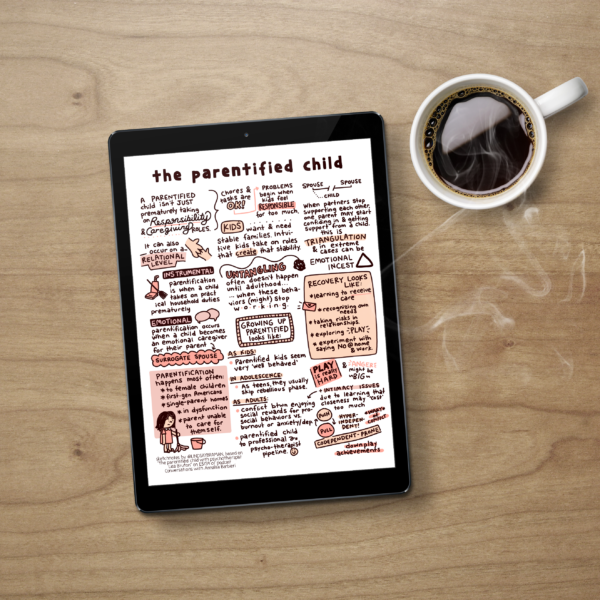
Without just regurgitating what you can read in this sketchnote, here’s what I want you to know about parentification: it’s not just about taking on responsibilities that are disproportionate to a child’s age – it can also be relational. So a family might put a child in a position where they need to take on household duties (like cleaning, childcare, cooking, etc.), or it may be relational. In that case, a child might be parentified by becoming an emotional caregiver for their parent – listening, encouraging, and regulating in ways that would be more appropriate to a spouse rather than a child. Therapists sometimes refer to this relational dynamic as a “surrogate spouse,” and it is a form of triangulation and, at extremes, what some therapists conceptualize as an emotional form of incest.
Parentification happens most often to female children, first-generation children of parents who immigrated, children in single-parent homes, children in homes with extreme dysfunction, and in families where one of the parents is unable to care for themselves.
It’s not that chores aren’t okay for kids – quite the opposite is true. Chores help kids gain responsibility and life skills. On the other hand, when kids feel responsible for the home, that responsibility can cut into the developmental tasks that are accomplished through play and growing up.
In homes where a parent is emotionally unwell or absent due to addiction or substance use, kids naturally want to move toward a more stable family system and will take on tasks, whether physical or emotional, to accomplish this stability.
Recovering from Parentification
Recovery from parentification is possible and part of healing from many disorders related to growing up in a dysfunctional family. While parentified kids seem really well-behaved as kids and often skip the rebellious phase of adolescence, parentified kids run into trouble as they reach adulthood, when the conflict between enjoying the social rewards of being a highly responsible person bumps up against the burnout or anxiety/depression of carrying disproportionately heavy burdens and caring for others.
Formerly parentified children may also move into caregiving roles like healthcare providers, therapists, and teachers due to an overdeveloped skill at attuning and providing care.
With good care in adulthood, kind and wise decision-making, and learning to share responsibilities—both emotional and physical—with others, formerly parentified children can overcome the challenges that this childhood experience creates and thrive. Recovery also often occurs through learning how to receive care, recognizing and naming one’s own needs, learning to take risks in relationships, exploring ways to play, and experimenting with saying no more often.
If this one-page PDF handout explaining what parentification is would be helpful for you or your clients, you can download it to print and use professionally. It is available as a single download in my shop – you’ll get a color and black-and-white PDF – or you can join my Patreon to get instant access to this plus hundreds of other illustrations, handouts, and worksheets.
Making This Sketchnote
I first encountered the concept of parentification long before I started graduate school to become a mental health counselor. In fact, parentification was a topic I encountered early in my own therapy in my 20s, so it’s something that I have personal experience untangling.
In fact, parentification is probably a big part of how I learned to communicate well through my visual art and through language, and develop some of the skills I use in running a business. Much of my work has been exploring, understanding, and reclaiming those strengths in the context of being parentified as a child who took on responsibilities inappropriate for my age.
Parentification is Complicated
Parentification is not a clinical diagnosis in the DSM. Rather, parentification is a concept that most therapists agree on, but like codependency, parentification lacks one common definition. In some ways, I like this because it allows for nuance and for people to identify with it if it resonates. In other ways, I think that it would be helpful to have a common, standardized definition.