Mental Health Impacts of ADHD-Related Learning Disorders
Most of us are gaining more awareness around the challenges that neurodivergent people face, but in this sketchnote, I illustrate another layer: the mental health impacts of learning with an ADHD-related learning disorder.
As more and more adults are able to access assessment and be diagnosed later in life with learning disorders, mental health professionals are identifying the ways that learning in a neurodivergent brain has impacted mental health. Here’s the bottom line: learning disorders aren’t just about education in school. They change how we interact with systems, language, and relationships—and those interactions shape our self-image, our financial security, and our perception of self-worth.
I made a sketchnote to make this information more available and more accessible to people who learn differently. After all, that’s a little bit of how I found my way to being a therapist turned mental health illustrator. I spent my whole educational journey translating between academia and the way my visual brain processes information. So, here’s an illustrated sketchnote about ADHD learning disorders for others who prefer information in a visual format. This illustration is available as a PDF in my shop or on my Patreon. You can use it as a conversation starter or a one-page handout to inform or advocate.
The PDF download includes 3 versions of the wheel: Full Vibrant Color, Black-and-White, and Greyscale (printer-friendliest).
I created the sketchnote while listening to a podcast titled The Overlooked Connection (Episode 239 of the Clearly Clinical podcast), in which Dr. Robin Raniero Norris, LMFT, presented their research on the mental health impacts of ADHD-related learning disorders.
What You’ll Find in this Sketchnote
ADHD learning disorders tend to fall into three categories: reading disorders called dyslexia, math disorders called dyscalculia, and difficulties understanding things that are visually communicated through writing or similar forms, called dysgraphia. Of course, this is an intense simplification, and at some point I would love to explore each of these learning disorders through their own illustration.
Dysgraphia is marked by struggles with handwriting, spatial planning, grammar, and syntax. In the mental health context, requiring that clients complete forms prior to a session can be a kind of barrier for people who have dysgraphia.
Dyscalculia may involve difficulty with number-related concepts, challenges with basic arithmetic, issues with spatial orientation, and sequential memory. Interestingly, many adults with dyscalculia who don’t receive care or support may have found their financial situation particularly stressful and may struggle managing money or planning for the future. Sometimes dyscalculia is diagnosed in couples therapy, when a couple’s frustration about money and how it is spent turns out to be an undiagnosed learning disorder.
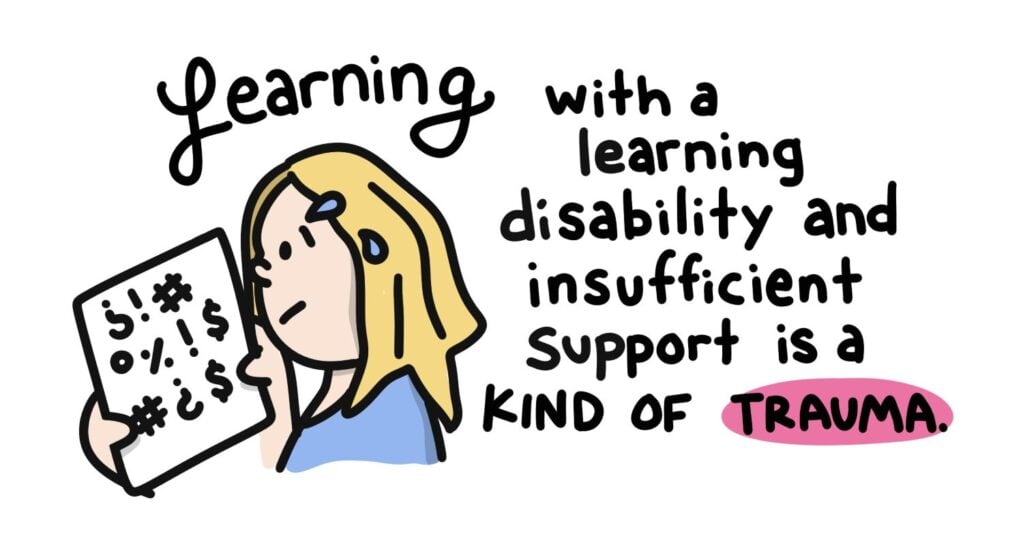
Learning in an educational context without support is a kind of trauma for many. Without support or acknowledgment of our struggle, we may assume that it’s our failing. After all, if we are trying really, really hard to learn something and continue to struggle, score poorly, or receive feedback that we need to work harder, it’s easy for that to begin to inform our self-worth. But if, instead, people around us can extend more empathy, and we can learn to advocate for ourselves, we can undo some of these mental health impacts of learning disorders and instead focus on adapting the ways that we learn.
Conclusion
I’m thankful for the conversation about neurodivergence and ADHD that has emerged in recent years. Dr. Robin Raniero Norris, LMFT, points out that the key to thriving is learning to decode – that is, recognizing that our brain may not process information in the same way and gathering tools, resources, and support to learn ways to decode and translate for the unique way that our brain learns.
For me, that’s meant translating. When I was studying for the board exams to become a mental health counselor, I pored through page after page of text-based study guides and converted my notes to a visual format that I now share on my Patreon and in my shop. One thing that has astounded me in my own journey to learn is just how much other people can benefit from the translation work that we can learn to do for ourselves. The lecture notes that I just needed to take in school turned out to be a key for many of my peers to understand concepts – and that’s the foundation of how my Patreon started.